


Over the past weeks, we have seen renewed discussion/concern in the MySQL community around claims that “Oracle has stopped developing MySQL” or that “MySQL is being abandoned.” These concerns were amplified by graphs showing an apparent halt in GitHub commits after October 2025, as well as by blog posts and forum discussions that interpreted these signals at face value.
As someone who has publicly analyzed the MySQL repository activity and who works daily with MySQL at Percona, I want to clearly separate what the data actually shows from what it does not.
This post should not be read as an uncritical defense of Oracle. We often disagree with Oracle’s decisions, and we say so openly. But fairness matters — especially when fear, uncertainty, and doubt (FUD) start affecting customers and the wider ecosystem.
The Claim: “Oracle Stopped Committing to MySQL After October 2025”
We recently had a surprising question from our community. Has MySQL really been abandoned? They also included the graph that was shared in Otto Kekäläinen’s post.
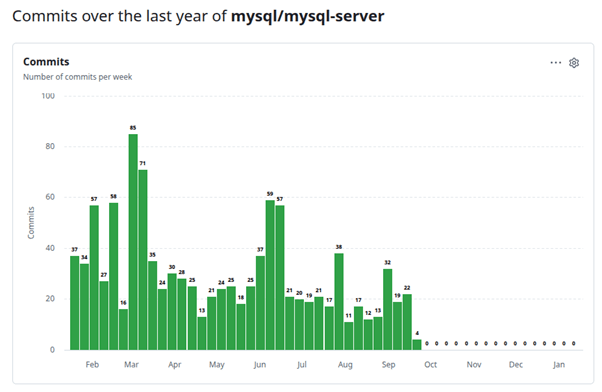
This conclusion is usually drawn from GitHub activity graph on the public https://github.com/mysql/mysql-server/ repository, which indeed shows long periods with no visible commits.
The graph itself is not wrong. But the interpretation is incomplete.
The Missing Context: How MySQL Is Actually Developed
The error lies in assuming that MySQL is developed on GitHub, which is not the case. For many years, Oracle has followed a specific workflow in which real-time engineering takes place in private, closed repositories. GitHub serves only as a public mirroring and publication platform rather than an active development workspace. As a result, code is released to the public in large, consolidated “code drops” that align with official releases, instead of appearing as incremental daily commits.
In other words:
GitHub is an asynchronous publication mirror, not the development system of record.
This means:
- A lack of incremental commits on GitHub does not imply a lack of development
- Long quiet periods are expected between release pushes
- Sudden large commit bursts are the normal release mechanism
This development model is not new, it has been this way for many years. Can one argue that this is not a “truly open source development model”? Maybe, but in the end, the same graph that was pulled on 21/01/2026 (after recent releases 9.6.0, 8.4.8, 8.0.45) doesn’t look abandoned anymore.
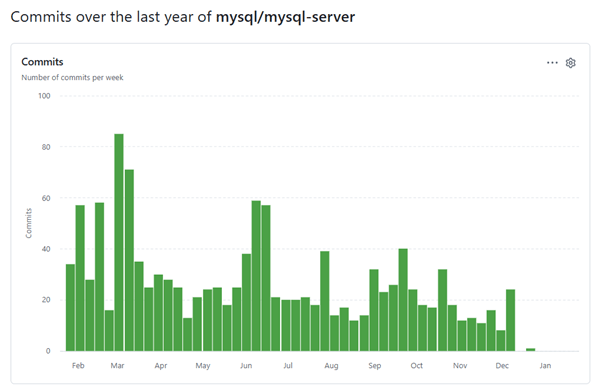
The MySQL “abandonment” narrative is a perfect reminder that metrics are only as good as our understanding of the systems they measure. A flatlining GitHub graph isn’t always a pulse check for a dying project; often, it’s just the silence of an engine running behind a closed door. While we can debate the transparency of Oracle’s development model, we shouldn’t mistake a different workflow for a lack of work. It’s not always as it seems, and it’s a mistake to judge a book by its cover, or a database by its mirror.






Otto’s blog post said
and so on. He was talking about long term decline. At no point did he claim that Oracle completely stopped developing MySQL in October 2025. Because the latter claim is very easy to prove wrong. Which this blog brilliantly does. But this wrong claim, that nobody made, doesn’t hide the real uncomfortable question, that Peter asked in his blog post — two years before mass layoffs made it obvious to everyone.
We are on the same page for the long term reduction on the number of commits. https://www.percona.com/blog/analyzing-the-heartbeat-of-the-mysql-server-a-look-at-repository-statistics/ While sharing the numbers, I also mentioned it might be because of reaching certain maturity level. It is important that we are fair as much as we can.
That is why we are part of the community effort; calling for action https://www.percona.com/blog/lets-rebuild-the-mysql-community-together/.
Yes you have a good point. Even though Otto never mentioned Oracle abandoning MySQL, we started getting questions from the community referring to the graph he shared. People who are close the MySQL code base know but we can’t expect all the community to know how to interpret that graph. Some explanation would have helped.
Our main goal is to unite the community rather than causing confusion and fear.