
Your company has invested heavily in agile development, microservices, and Kubernetes to move faster. Your app teams can spin up a new service in minutes. So why can it still take a week to get a database for it?
The bottleneck has shifted. It’s no longer compute; it’s the database. Manual, ticket-based provisioning still dominates, forcing developers to wait days for something they should be able to create instantly.
That delay can get expensive.
Our latest analysis found that a single manual database request costs an average of $1,140 in human capital, representing lost time for developers waiting, DBAs executing, and managers approving. Multiply that by every ticket, every sprint, and every stalled feature release, and the cost to innovation becomes staggering.
Most organizations have already containerized their applications, but the database remains the last piece of infrastructure that resists automation. Until it joins the same cloud-native operating model, transformation remains incomplete.
The good news is that this friction is now optional. By moving your databases to Kubernetes, you can turn provisioning into a self-service process, eliminate ticket queues, and finally unlock the developer velocity your teams were promised.
Here’s what that shift actually looks like in practice.
A developer files a ticket. It waits in a queue. A DBA manually provisions the database, reviews configurations, and hands it off. That’s days or sometimes weeks of delay before a single line of code can be tested.
A developer defines a database as code, just like any other service. A Kubernetes operator automatically provisions, configures, and manages it. In minutes, a fully compliant, production-ready database is live.
Just so we’re clear, this isn’t about replacing your DBAs. It’s about liberating them. You stop paying your database experts to perform manual, repetitive provisioning and patching. You free them to focus on high-value strategic work: performance optimization, query tuning, and building a data architecture that gives you a competitive edge.
The difference is a complete transformation of your operating model:
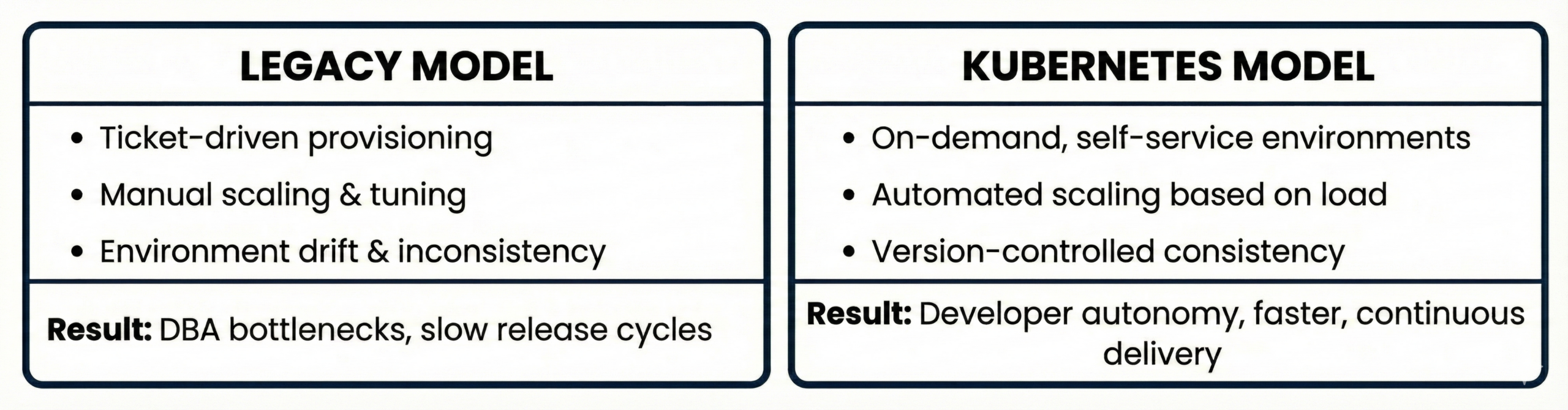
When developers can self-serve databases, your database experts shift their focus from maintenance to innovation, concentrating on architecture, optimization, and performance.
This is usually the point where someone says, “We’ve already solved this. We pay for a managed DBaaS from our cloud provider.“
Unfortunately, that’s just swapping one bottleneck for another. You’ve traded a process one for a strategic one.
Kubernetes brings balance back. It delivers DBaaS-like automation and scalability without sacrificing control or incurring vendor fees.
When Nokia’s internal development teams demanded faster access to databases, their central IT group faced a choice: scale manual DBA operations or rethink their entire approach.
They chose the latter.
Using Percona Operators, Nokia built a self-service Database-as-a-Service (DBaaS) on Kubernetes, which powers one of the world’s largest private clouds, utilizing more than 700,000 cores. Developers can now create databases in minutes, without requiring approvals or manual setup, and without being locked into a proprietary vendor.
The result: Nokia delivers databases on demand at massive scale, enabling its teams to move faster without a surge in manual operations or cost. See how Nokia achieved this with Percona’s open source database software, transforming one of the world’s largest private clouds into a high-velocity environment that delivers self-service access without compromising security, governance, or control.
Every organization that has modernized its CI/CD pipelines faces the same gap. Databases still operate on a slower, ticket-driven model, and closing that gap is what finally delivers on the promise of full cloud-native agility.
This blog shows why Kubernetes databases are the key to developer velocity. Our new research paper, Take Back Control of Your Databases, provides the how.
It’s the C-level playbook for leading this transformation. Inside, you’ll find:
And while you’re here, check out Open Source Unplugged, Percona’s no-BS webinar series where top tech leads share real-world challenges, live demos, and practical solutions for open source databases.