Choosing the right Kubernetes operator is one of those quiet decisions that ultimately defines your database strategy, affecting everything from how easily you automate backups and scaling to how much control you maintain over long-term costs and architecture.
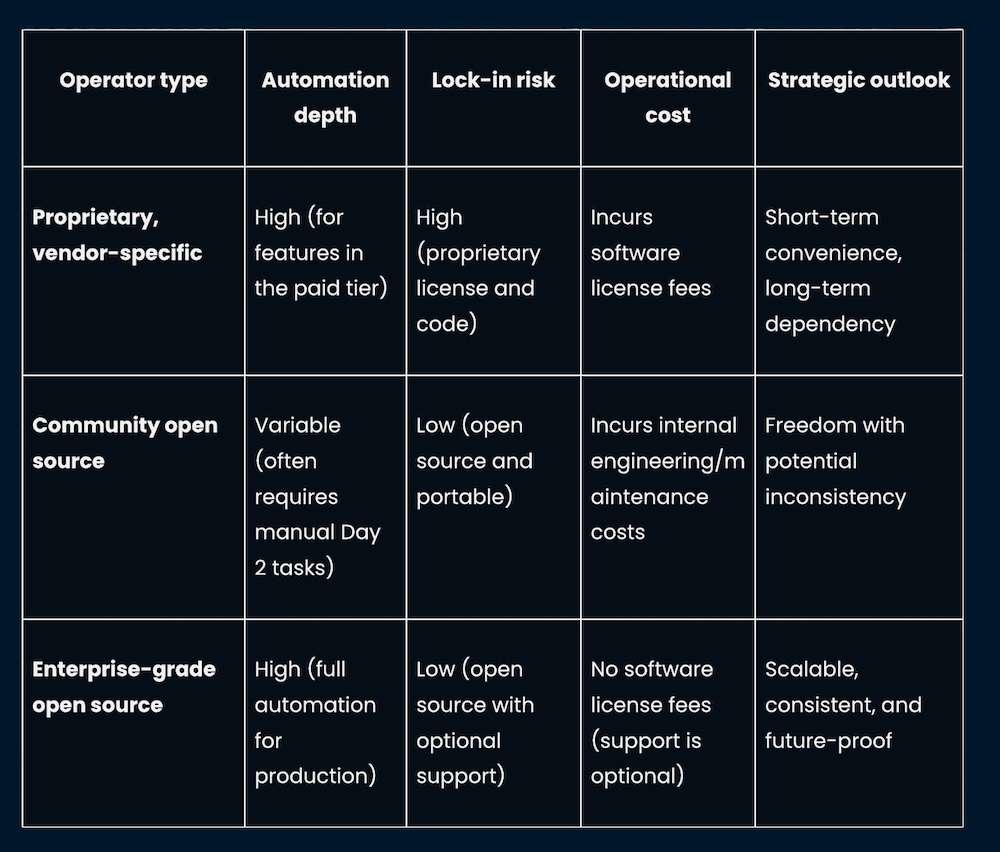
But while most operators look similar at first glance, their underlying models yield vastly different outcomes. Some models deliver powerful automation but only within a proprietary, licensed ecosystem, creating vendor dependency. Others offer open source flexibility but may require significant, hands-on maintenance from your internal teams. Before you commit, it’s crucial to understand these categories and how each one will shape your long-term scalability, resilience, and TCO, especially when Kubernetes operators compared side by side reveal very different trade-offs.
Each type of operator takes a different approach to automation, control, and long-term flexibility, and these differences become apparent quickly when scaling or meeting new architectural or compliance demands.
These operators are developed by commercial database vendors and typically deliver mature automation capabilities from initial deployment. But that convenience comes at a cost. The advanced features are typically tied to paid enterprise editions, and the code is closed. Over time, your architecture, pricing, and upgrade path end up dictated by a single vendor’s roadmap.
What starts as simplicity can quietly become a new kind of lock-in.
Community operators are open source projects developed by the broader ecosystem, offering transparency with no licensing fees. The trade-off is that some community operators may not include the same level of advanced automation in areas such as rolling upgrades, failover orchestration, or integrated monitoring. Running them at scale often means dedicating internal engineering resources to fill those gaps, turning free software into an expensive maintenance project.
This third model aims for a balance, blending the flexibility of open source with the reliability of a commercial product. These operators are typically built on an open source core but are hardened, tested, and commercially supported for production use across major clouds and Kubernetes distributions.
This model provides organizations with a clear path to standardize operations across databases and environments, without the lock-in or licensing constraints associated with proprietary tools.
The choice of an operator defines the technical capabilities, resilience, and cost model for database management. As you evaluate your options, use these four business outcomes as a benchmark.
Every layer of automation reduces human hours, cuts unplanned downtime, and minimizes cloud waste. An operator with built-in, intelligent scaling and recovery features reduces the need for manual intervention, directly lowering operational overhead.
Business continuity depends on how fast systems recover. A production-ready operator delivers high availability and automated failover, keeping databases running through node failures, cloud disruptions, or routine maintenance. This is the difference between a minor hiccup and a costly outage.
Scaling databases shouldn’t mean scaling headcount. A strong operator handles load balancing, provisioning, and complex upgrades automatically, allowing your platform to grow seamlessly with demand. This predictability enables you to plan capacity and performance using data, rather than relying on guesswork.
Modern data environments cross clouds, regions, and regulatory boundaries. The right operator ensures that backup policies, access controls, and encryption standards are enforced consistently and not reinvented per cluster or vendor. That consistency reduces audit risk and strengthens your security posture.
The operator you choose helps define how efficiently your organization operates. With the right automation foundation, you gain control over costs, confidence in resilience, and the flexibility to adapt faster than your competitors, which is exactly what Percona’s open source operators are built to do.
As we’ve explored, the operator market forces a difficult trade-off. Proprietary vendors offer automation but create lock-in, with license models and roadmap restrictions that serve their ecosystem, not yours. Community operators promise open source freedom but often vary in production readiness, leaving your team to fill critical gaps in upgrades, failover, and observability.
Our operators for MySQL, PostgreSQL, and MongoDB are built to resolve this conflict. They are built on a 100% open source foundation, delivering consistent, enterprise-grade automation across every database. You get the reliability you need without the licensing limits of proprietary vendors or the uncertainty of community projects.
That consistency matters most when you compare it to what’s available elsewhere. Here’s how Percona’s Operators stack up.
The PostgreSQL ecosystem includes several operators with Apache 2.0 open source licenses, including EDB’s CloudNativePG (a CNCF project), Crunchy Data’s PGO, and the Percona Operator. The primary difference is the business model: EDB often pairs CloudNativePG with its commercial Postgres Advanced edition, and Crunchy Data offers a subscription-based product built around its operator.
The Percona Operator for PostgreSQL offers key enterprise capabilities, including automated and safe operator upgrades, a process that is manual for EDB, Crunchy, and Zalando. It also provides scheduled backups, point-in-time recovery, built-in HA, and OpenShift certification, and supports comprehensive observability via Percona Monitoring and Management (PMM), a complete solution not offered by competitors.
Unlike the commercial models from EDB and Crunchy Data, Percona provides every automation feature openly, with no software license tiers. The Percona Operator is tested for enterprise-scale production deployments, and Percona offers optional, paid support for it.
The result: full automation without paying for proprietary enterprise layers.
Many organizations still rely on Oracle’s MySQL Operator for Kubernetes or utilize cloud-managed DBaaS options such as Amazon RDS and Azure Database for MySQL. These models present a trade-off. DBaaS automation is tied to a single cloud provider, while Oracle’s operator model splits its features. Key capabilities like automated upgrades and data-at-rest encryption are absent from the free Community Edition, requiring a paid Enterprise Edition license.
Percona now provides two fully open source MySQL operators. The new Percona Operator for MySQL, based on Percona Server for MySQL, supports MySQL native replication, including GA support for Group Replication and asynchronous replication in technical preview. The Percona XtraDB Cluster (PXC) Operator continues to offer Galera-based synchronous replication for workloads that require strict consistency. Both operators remain fully supported and actively developed, giving organizations flexibility to match replication models to workload needs.
Both operators provide critical features that neither Oracle edition offers, such as integrated multi-cloud deployment and Red Hat OpenShift certification. They also enable automated scaling and recovery across any Kubernetes environment, whether AWS, Azure, Google Cloud, or on-premises.
They include ProxySQL and HAProxy for built-in load balancing and support Percona Monitoring and Management (PMM) for observability. This is a key differentiator, as Oracle’s operator does not include a monitoring solution in either its Community or Enterprise edition. With Percona’s Operators, you get these capabilities on any platform, with no proprietary software dependency and no bundled infrastructure markup as charged by DBaaS providers.
MongoDB’s Enterprise Kubernetes Operator delivers strong Day 2 automation, but only for customers licensed under MongoDB Enterprise Advanced. Its community operator offers a limited subset of that functionality, lacking critical features like multi-cloud support, any built-in backup and restore capabilities, and sharded cluster automation, while also lacking enterprise support.
Percona Operator for MongoDB provides the same level of automation depth, including automated backups, rolling upgrades, sharding support, point-in-time recovery, and support for monitoring with Percona Monitoring and Management (PMM), while being fully open source. This allows your organization to standardize MongoDB on Kubernetes without per-node enterprise fees or reliance on Atlas’s managed environment.
With Percona, you own the data, the automation, and the cost model.
Percona Operators apply transport and at-rest encryption across all supported databases and integrate with major key management systems, including AWS KMS, HashiCorp Vault, and KMIP. These controls allow data protection policies to be applied consistently, no matter where workloads run.
By contrast, vendor operators often fragment these features, locking critical compliance controls behind enterprise editions. For example, MongoDB’s Community Edition operator lacks Data at Rest Encryption, key management (KMS) integration, Auditing, and Role-Based Access Control, all of which require a paid Enterprise Advanced license.
Percona’s unified approach gives platform teams a single, policy-driven security model that spans MySQL, PostgreSQL, and MongoDB. Every Percona Operator is Red Hat OpenShift certified, meeting the standards required for production in large-scale enterprise environments.
Visibility and control are crucial for managing databases at an enterprise scale, and Percona Operators provide native integration with Percona Monitoring and Management (PMM), giving teams real-time performance insights across MySQL, PostgreSQL, and MongoDB clusters, wherever they run.
Metrics are collected natively from each database pod and sent securely to your PMM server, creating a single view of query performance, resource utilization, and availability across environments.
In contrast, vendor operators often limit observability to their own ecosystem or tie monitoring to premium tiers and proprietary dashboards. With Percona, you gain unified visibility across every deployment — whether it’s on AWS, Azure, Google Cloud, or on-premises — without licensing costs or vendor lock-in.
And because all Percona Operators share the same automation framework, multi-cloud and hybrid operations remain consistent. Workloads can move freely between clouds or clusters while retaining the same monitoring, security, and governance policies.
For more in-depth details, see how all our Operators compare against the other options.
The Kubernetes operator market often forces a choice between two extremes. Vendor operators lock critical features, such as data-at-rest encryption or auditing, behind their paid enterprise licenses. Community operators, while flexible, may require manual processes for key tasks like operator upgrades, which are automated in other solutions.
Percona delivers enterprise-grade automation across all major open source databases (MySQL, PostgreSQL, and MongoDB). This automation is fully supported, 100% open source, and portable across any Kubernetes environment.
For organizations pursuing a cloud-native strategy, Percona’s model provides a consistent automation framework for all three databases, which standardizes monitoring and security. This open source model eliminates software license costs and, by being fully portable, avoids proprietary vendor lock-in.
See how Percona Operators help you take back control
Get started with Percona Operators and see how consistency, scale, and freedom come together.
Resources
RELATED POSTS