
Migrating mission-critical databases is often compared to changing the engines on a plane while it’s in mid-flight. For MongoDB users, this challenge has been historically steep, often involving complex workarounds or proprietary tools that keep you locked into a specific ecosystem.
Today, we are thrilled to announce the General Availability of Percona ClusterSync for MongoDB (PCSM). This new addition to the Percona Software for MongoDB suite is a powerful, cluster-to-cluster synchronization tool designed to make migrations between Percona Server for MongoDB and genuine MongoDB databases as seamless as possible.
PCSM is designed to enable near-zero downtime migrations from MongoDB Atlas or MongoDB Community / Enterprise Advanced, or when simply moving between different environments.
What is Percona ClusterSync for MongoDB?
At its core, PCSM is a synchronization engine that facilitates high-speed data transfer (data clone) and real-time replication between two MongoDB clusters. By utilizing MongoDB Change Streams, PCSM ensures that every insert, update, delete, and DDL operations on your source cluster is reflected on the target with minimal latency.
Key Technical Highlights:
- Replica Set and Sharded Topology: PCSM is built for modern architectures. It natively supports both replica set and sharded cluster topologies, allowing you to scale your migration strategy to match your production needs.
- Real-time Replication: After the initial data “cloning” phase, PCSM enters a continuous sync state, keeping the target cluster up-to-date until you are ready for the final cutover.
- Near-Zero Downtime Migrations: Because the source remains fully writable during the sync, you can perform migrations with near-zero application downtime.
- Versatile Use Cases: Beyond migrations, PCSM is an excellent tool for:
- Disaster Recovery: Maintaining a “cold-copy” or secondary cluster in a different region.
- Load Testing: Creating a real-time clone of production data to test application performance under stress without impacting live users.
The Open Source Difference: Navigating the Competition
Choosing the right synchronization tool is a pivotal decision for any database administrator. With the General Availability of Percona ClusterSync for MongoDB, the market now has a reliable, 100% open source alternative to proprietary and open-core tools.
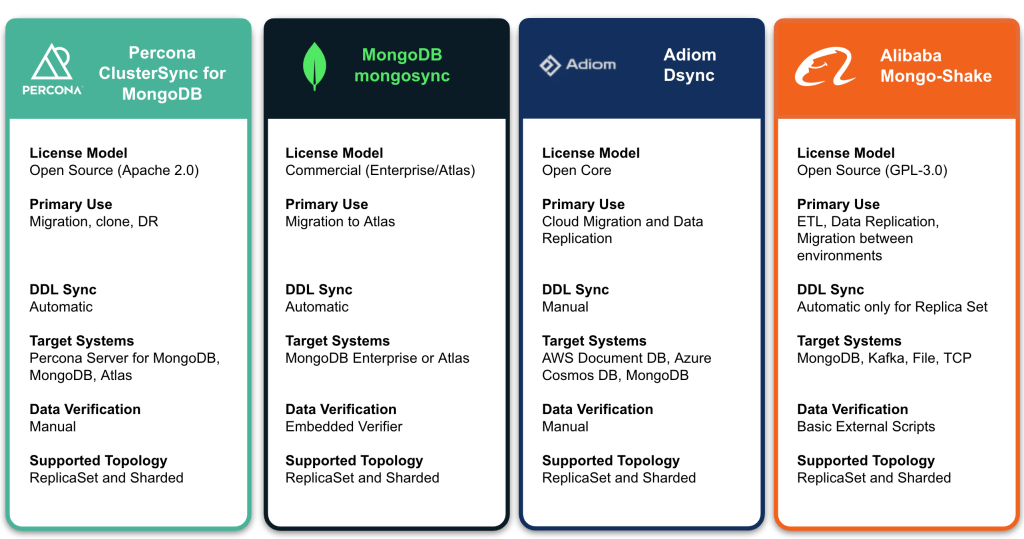
Percona ClusterSync for MongoDB
Percona ClusterSync for MongoDB stands out as a genuine open-source alternative. It provides the reliability and vendor-backed quality that enterprises demand, without the restrictive licensing or “walled garden” approach of proprietary tools. With Percona, you get the software for free and have the option to lean on our world-class support team to ensure your migration is successful.
MongoDB mongosync
The official utility from MongoDB Inc., specifically built for moving workloads into Atlas or between Enterprise clusters. It uses Change Streams for high-level replication.
- Limitation: It is strictly tied to Enterprise Advanced or Atlas deployments.
Adiom dsync
A lightweight, single-binary tool optimized for high-speed migrations, particularly from MongoDB to Azure Cosmos DB. It is popular for its simplicity and “zero-storage” transfer.
- Limitation: The open-source version is highly restricted. It does not replicate indexes or DDL statements, meaning you must manually set up your schema and indexes on the destination. It also lacks conflict resolution, defaulting to overwriting data. Large databases also require a commercial license. See details in their Adiom’s dsync documentation page.
Alibaba Mongo-Shake
A “universal platform” that treats the Oplog as a stream. It is the best choice if your target isn’t a database—for example, if you need to pipe MongoDB changes directly into Apache Kafka.
- Limitation: The open-source version lacks Active-Active setup support, which is present in Alibaba’s internal version. It’s challenging to set up such an environment without complex manual namespace filtering to prevent infinite loops. Additionally, DDL operations are not synchronized from sharded clusters. For details, refer to their GitHub repository for Mongo-Shake.
Current State: Version 0.7.0 and the Road Ahead
We are currently at the 0.7.0 release stage, which marks our General Availability (GA). The GA status indicates that the tool has met the stability and reliability milestones required for enterprise use. You can confidently deploy it in production for data migration across replica sets with near-zero downtime. This release also introduces data replication in sharded clusters, currently in a technical preview stage. While not yet GA, this feature is available for testing. We encourage you to try it in non‑production environments and share feedback to help shape future improvements. We have already received fantastic feedback regarding its reliability in the field, and we are just getting started.
Being in this early stage means that while the core engine is rock-solid, we have a packed roadmap for 2026. You can expect major feature additions—including performance boosts, better index build control management, and replica set to sharding replication—as we move toward the milestone 1.0.0 release later this year.
Join the Community
Percona thrives on community collaboration. As we continue to refine PCSM and celebrate its production-ready GA release, we invite you to get involved. We welcome reports of bugs, suggestions for new features, and code contributions. Your input helps us build the tools the MongoDB community actually needs. We encourage you to deploy PCSM in your production environments today! Check out the PCSM repository and join the journey with us!
Ready to break free from vendor lock-in? Check out the PCSM Documentation to get started with your first sync today.
About the Author
 Radoslaw Szulgo
Radoslaw is a Senior Product Manager at Percona and responsible for driving Percona Software for MongoDB. He has more than 15 years of experience in building distributed applications as a product manager, leader, and software engineer. Radek is an Agile product development enthusiast and fan of personal development. Outside of work, he's an amateur volleyball player.