My previous post (Performance Progression of Percona Server for MySQL 8.4) did a brief review of the performance changes in Percona Server for MySQL 8.4 released in 2026. I recommend reading it first to better understand the material in this post.
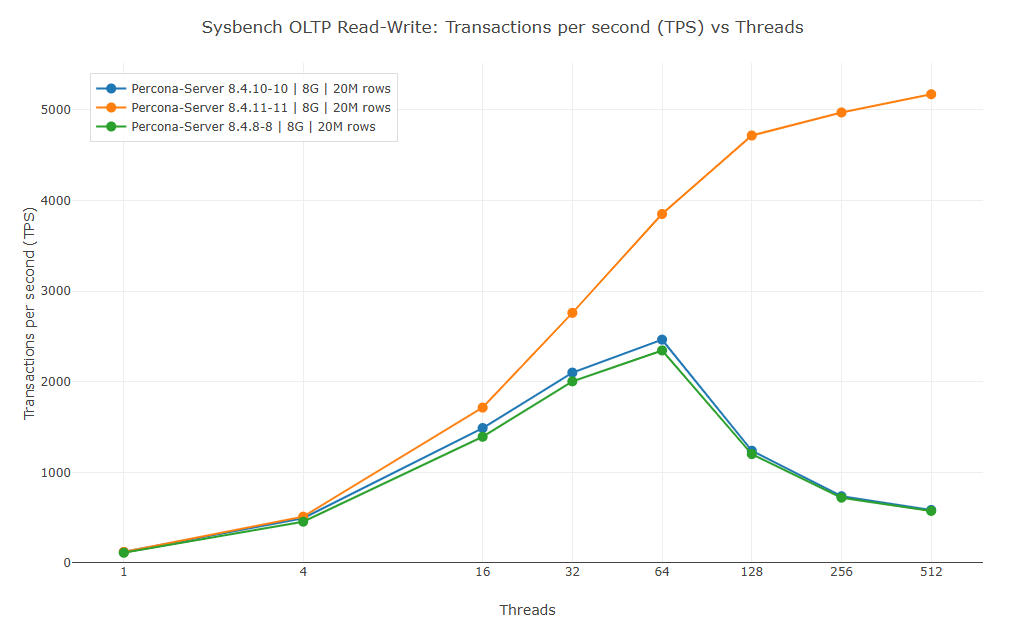
Version 8.4.11-11 includes patches that deliver significant improvements in performance and scalability.
One of the most impressive illustrations of the performance bump is reflected in the following graph:
Graph 1 – Percona-Server 8.4.X with 8G buffer [ INTERACTIVE GRAPH ][ TABLE ]
There are two separate improvements in the version 8.4.11-11:
All code changes improved the performance of the InnoDB buffer pool and the way it handled pages flushing.
InnoDB is the default storage engine in Percona Server for MySQL. Therefore, InnoDB performance influences the overall performance of the database server.
The InnoDB engine has a buffer pool, which is basically a data cache in RAM. Instead of reading from disk for every query, the server keeps the most-used data pages in memory.
Its performance matters because:
InnoDB stores data in fixed-size pages (16 KB by default). Tables and indexes are split into pages, and a page is the unit that moves between disk and the buffer pool – it never reads a single row from disk, always the whole page containing it.
To better understand the mechanism responsible for the InnoDB buffer pool handling of pages we need to explain the Least Recently Used (LRU) concept.
LRU is the strategy used to decide which pages should be removed from the buffer pool when space runs low. All pages in memory reside in a list ordered by usage: recently accessed pages stay near the “hot” end, untouched ones drift to the “cold” end, and get evicted first. This keeps frequently used data in fast memory, while rarely used data is written back to disk.
The code is available in the GitHub repository for anyone to see:
https://github.com/percona/percona-server/
Significant improvement for read-heavy (IO-bound) workloads. Previously, every physical page read held the pool-wide LRU list mutex while doing extra work, including zeroing a 16 KB page frame – so all reads on a buffer pool instance were serialized on one lock. Now the mutex only covers the actual LRU list insertion, and the rest runs under a much finer-grained page-hash latch. As a result, pages could temporarily become visible in the page hash table prior to their insertion into the LRU list, which requires careful handling in the codebase. Physical reads can now proceed in parallel rather than queueing behind one another. It also fixes a related race (PS-9837) and removes LRU-mutex contention from the purge thread.
NOTE: This improvement was possible by analyzing the lock waits in the profiling data, which pointed to the most contended mutex, which was in LRU list.
In this multi-patch ticket the LRU threads were restored to their original state and a few other performance improvements were done.
(GitHub: 53bb2f0f)
With this patch each buffer pool instance gets its own background thread that evicts and flushes cold pages to keep free pages available. When this is not done, user queries needing a free page might start doing cleanup work inline during the query execution, which increases the execution time.
(GitHub: 37cdd537)
This commit has no direct performance impact.
(GitHub: 1a1185b4)
Adds the ON/OFF switching for the LRU manager through innodb_lru_threads system variable. Also, the patch restructures flush statistics, so LRU threads don’t need to synchronize with each other when updating counters – stats are aggregated by a single coordinator thread.
(GitHub: c80f16557)
The LRU thread adapts how long it sleeps based on whether it is “making progress”. In the previous implementation only flushing pages counted as progress, so freeing memory by evicting clean pages looked like failure and made the thread back off wrongly. Now evictions count as progress too, so the LRU thread avoids backing off under clean-page workloads.
(GitHub: 2624d116)
Fixes a low-concurrency throughput drop: when a background LRU batch was already running, a user thread needing a free page always sat waiting for the whole batch to finish. Now the thread first scans for a page it can free immediately, only waits when it truly has to, and never waits twice in one call (avoiding starvation). Adds two monitoring counters for observability.
(GitHub: dc344fba)
This improvement fixes a bug when the background flusher wasted CPU time re-scanning the same pages over and over because it started from LRU tail each time. After the fix, the LRU scan iterator remembers where it left off and continues from there.
NOTE: This bug existed in MySQL and Percona Server for MySQL for a long time unnoticed. It was discovered only because the LRU code was re-assessed for possible performance improvements.
The overall performance improvements were delivered by: faster physical reads through much less lock contention (PS-11444), background threads keeping free pages ready so queries don’t stall on evictions (PS-11445) and no wasted rescanning in the flusher (PS-11446).
Resources
RELATED POSTS