
If your database is getting slower, your users don’t care why. They just want it to work.
Meanwhile, you’re stuck dealing with the symptoms: sluggish apps, spiking resource usage, and support tickets piling up faster than your monitoring alerts can handle.
Often, the problem isn’t with your queries or hardware; it’s with how your application handles connections. Every microservice, user request, and background job wants its own pipeline to the database. Before long, your PostgreSQL server is drowning in open connections, burning CPU just to manage traffic instead of doing actual work.
This utility isn’t flashy, but it’s essential. PgBouncer helps PostgreSQL handle high-concurrency workloads by efficiently managing and pooling connections. If you’re running a growing application or just trying to keep things stable under pressure, PgBouncer might be the most important tool you’re not using yet.
Simply put, PgBouncer manages connections to your database. But let’s break that down in a way that actually matters to you.
Every time an application opens a connection to PostgreSQL, it costs something: memory, CPU, or overhead to manage that session. PostgreSQL wasn’t built to handle hundreds or thousands of these at once. Left unchecked, you hit connection limits quickly.
The result?
Timeouts, dropped requests, slower response times… and frustrated users.
PgBouncer sits between your application and PostgreSQL and handles that chaos for you. It keeps a small pool of persistent connections and routes requests through them. It’s:
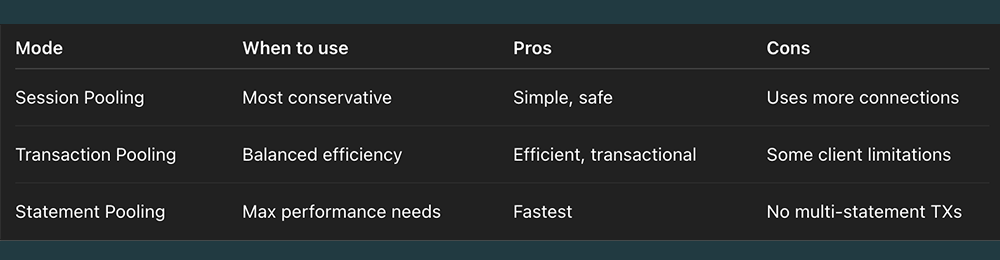
To preserve transaction behavior, PgBouncer offers different pooling modes:
…then you’re already a prime candidate for PgBouncer. It’s one of those tools that, once it’s in place, you wonder how you ever ran without it.
You’re probably already watching query performance, tuning indexes, and experimenting with caching layers. But if connection management isn’t part of your strategy, you’re leaving a significant bottleneck untouched.
Here’s where PgBouncer quietly becomes a critical piece of your PostgreSQL stack:
When connection counts spike, whether from users, scheduled jobs, or microservice traffic, PostgreSQL starts to drag. Each connection consumes memory and requires backend processes, even when idle.
PgBouncer controls this load by reusing connections instead of constantly creating new ones. Fewer connections means less overhead and better throughput. Your users won’t see the difference in your setup, but they’ll feel it in response times.
If you’ve moved to microservices (or are considering it), you know what happens: every service wants its own persistent database connection. Multiply that by instance count, and you’ll hit your max_connections limit fast.
PgBouncer keeps things manageable. It supports high-concurrency applications by efficiently queuing and routing traffic, especially in transaction pooling mode, where connections are reused between transactions without holding idle sessions.
You won’t need to constantly adjust connection limits just to keep your services talking to the database.
PostgreSQL doesn’t handle idle connections well. Every idle session still uses memory, and too many can overload your server without warning.
PgBouncer reduces this waste, freeing up compute and memory to focus on active queries, the work that actually moves your application forward.
PgBouncer doesn’t handle failovers on its own, but it can be a key part of a highly available PostgreSQL setup. When used with tools like HAProxy, Patroni, or custom health checks, it helps reroute traffic to the right database node, whether that’s a read replica or a new primary after failover.
That means fewer connection errors, less downtime, and a more graceful experience during HA events. PgBouncer helps reduce the chaos and keep things running smoothly when infrastructure shifts.
At the end of the day, this isn’t just about performance. It’s about fewer middle-of-the-night alerts, fewer mysteries in your dashboards, and more predictable PostgreSQL behavior under load.
If you’re scaling a product, supporting a high-traffic platform, or managing a growing team of internal users, PgBouncer gives you breathing room.
If PgBouncer sounds like something your PostgreSQL environment needs, the next question is: How should you roll it out?
There are a few ways to approach it. Some give you full control, and others add cost or complexity. Here’s what to consider:
You can always install and configure PgBouncer yourself. It’s open source, well-documented, and flexible enough to fit into most environments. That said, it’s not exactly plug-and-play.
Side note: As your PostgreSQL-based applications grow, you might hit connection limits faster than expected. Since PostgreSQL doesn’t include a built-in connection pooler, it’s important to plan for one early. This blog post breaks down your options and explains how connection pooling can impact performance.
You’ll need to think through:
It works, but it can become one more moving piece your team has to own and troubleshoot.

Some commercial PostgreSQL vendors include PgBouncer in their software packages, which can make setup a bit easier. But before you commit, consider what you’re trading:
You might solve one problem—setup—but introduce others around flexibility, cost, and long-term control.
Percona includes PgBouncer as part of our production-ready PostgreSQL solution, fully tested and integrated with the rest of the stack.
Here’s what that means for you:
You’re not just getting PgBouncer, though; you’re getting a setup that works out of the box, in production, without guesswork.
Connection issues aren’t always obvious. You might not see an error message or a crashing service, but you’ll feel it in the form of random slowdowns, stuck queries, or resource spikes that don’t add up.

If any of that sounds familiar, PgBouncer is a way to protect your PostgreSQL environment from growing pains before they turn into real outages.
Whether you’re managing a complex app, supporting dashboards, or trying to keep things smooth as user load grows, PgBouncer helps ensure PostgreSQL stays efficient, responsive, and stable. And when it’s built into your open source, enterprise PostgreSQL setup, it’s one less thing to worry about.
With Percona for PostgreSQL, you get more than just a database. You get an enterprise-ready suite of open source software, tools, and services required to deploy and maintain a reliable production cluster for PostgreSQL, enhanced with extensions from the community that are certified and tested to work together. No license fees, no usage restrictions, and no lock-in.
 Enterprise-grade connection pooling: PgBouncer is pre-integrated and tested as part of Percona’s enterprise-ready architecture. It’s configured to work seamlessly alongside tools like Patroni, pgBackRest, and pg_stat_monitor, so you’re not left troubleshooting compatibility issues on your own.
Optimized for modern deployments: Whether you’re running PostgreSQL in containers, across clouds, or on bare metal, Percona for PostgreSQL gives you the flexibility to deploy PgBouncer wherever your workloads live.
Expert help when you need it: Percona’s support team understands PostgreSQL inside and out, including PgBouncer. From performance tuning to production issues, you’ll have direct access to real expertise 24/7.
You don’t need to roll your own connection pooling solution or risk downtime by ignoring the problem altogether. With PgBouncer included in Percona for PostgreSQL, your applications stay responsive, your infrastructure stays efficient, and your team stays focused.

PgBouncer is a lightweight connection pooler for PostgreSQL that helps manage and optimize database connections. Instead of each client creating a new connection to PostgreSQL, PgBouncer maintains a pool of reusable connections, reducing memory usage and CPU overhead. This allows PostgreSQL to handle high-concurrency workloads more efficiently, especially in environments with microservices, background jobs, or high user traffic.
In production environments, PgBouncer helps prevent performance degradation caused by too many simultaneous or idle database connections. It improves throughput by reusing existing connections, which reduces latency and resource strain on your PostgreSQL server. PgBouncer is especially valuable for scaling applications, ensuring smooth performance during peak loads, and enhancing reliability during failovers when paired with HA tools like HAProxy or Patroni.
PgBouncer supports three pooling modes:
Each mode has trade-offs between compatibility and performance, so choosing the right one depends on your application’s behavior.