

 I was looking for a tool that could evaluate MongoDB performance under a complex workload, besides simple key-value operations that benchmarks like YCSB provides.
That’s why the paper “Adapting TPC-C Benchmark to Measure Performance of Multi-Document Transactions in MongoDB” got my attention and I decided to try the tool https://github.com/mongodb-labs/py-tpcc mentioned in the paper.
Py-tpcc, as the name implies, tries to emulate queries and schema as specified in TPC-C specification, with the adaption of both schema and queries to MongoDB transactional dialect.
The concern I have about a benchmark using python script is that Python is known for high CPU consumption, and I want to evaluate if py-tpcc can provide the workload to fully utilize server capacity and if the bottleneck won’t be on the client-side itself, rather than on the server-side.
So let’s take a look at py-tpcc.
For the client and server, I will use identical bare metal servers, connected via 10Gb network.
The node specification:
|
1 2 3 4 5 6 7 8 9 10 11 12 13 14 |
# Percona Toolkit System Summary Report ###################### Hostname | beast-node4-ubuntu System | Supermicro; SYS-F619P2-RTN; v0123456789 (Other) Platform | Linux Release | Ubuntu 18.04.4 LTS (bionic) Kernel | 5.3.0-42-generic Architecture | CPU = 64-bit, OS = 64-bit # Processor ################################################## Processors | physical = 2, cores = 40, virtual = 80, hyperthreading = yes Models | 80xIntel(R) Xeon(R) Gold 6230 CPU @ 2.10GHz Caches | 80x28160 KB # Memory ##################################################### Total | 187.6G Swappiness | 0 |
For MongoDB I used a single node instance, configured as a non-sharded Replica Set with 1 node.
The first step is to load data into the database, and actually I also wanted to compare different MongoDB versions, so these are the versions I tried:
To load data with py-tpcc, we execute:
|
1 |
tpcc.py --config mconfig --warehouses 100 --no-execute mongodb |
This will load the data for 100 warehouses (it should be about 10Gb of raw data). The first surprise comes from the execution time of this command.
For Percona Server for MongoDB 4.0.18-11 it was:
|
1 2 3 4 5 6 7 |
time ./tpcc.py --config mconfig --warehouses 100 --no-execute mongodb 2020-06-10 08:55:37,273 [<module>:245] INFO : Initializing TPC-C benchmark using MongodbDriver 2020-06-10 08:55:37,274 [<module>:255] INFO : Loading TPC-C benchmark data using MongodbDriver an real 87m45.815s user 83m3.677s sys 4m12.884s |
That is 87min 45sec, which is too long.
When we try to profile it, we can see that the server-side is practically idle, and the client-side has 1 CPU core 100% busy, which indicates that the bottleneck is on the client data generation side.
How can we improve Python?
I personally followed project PyPy for quite a long time, so now it is a good time to see if using py-tpcc under PyPy will improve things:
|
1 2 3 4 5 6 7 |
time /mnt/data/vadim/bench/pypy2.7-v7.3.1-linux64/bin/pypy tpcc.py --config mconfig --warehouses 100 --no-execute mongodb 2020-06-10 12:00:16,647 [<module>:245] INFO : Initializing TPC-C benchmark using MongodbDriver 2020-06-10 12:00:16,647 [<module>:255] INFO : Loading TPC-C benchmark data using MongodbDriver real 9m34.223s user 5m29.182s sys 0m36.051s |
Well, that’s quite an improvement. Now the execution time is 9m 34sec, instead of 87min 45 sec. 9 times faster! The resulting database size is 15GB.
Let’s compare load time for all MongoDB versions under PyPy:
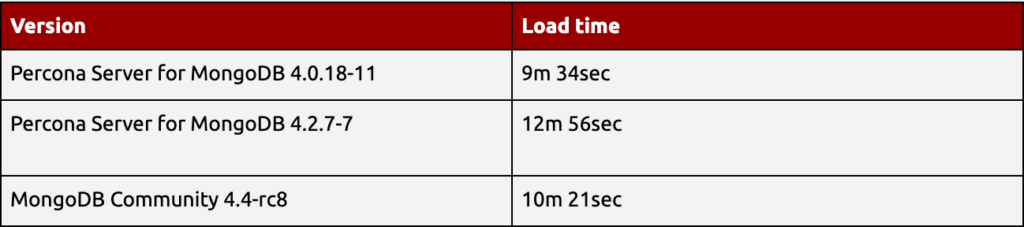
It seems in 4.2 the load time increased, but then was improved in 4.4 version. Now that we have loaded the data, we can run the benchmark itself, as well.
I will run the benchmark for 900 sec, and the tool will report the amount of NEW_ORDER transactions executed during this time. I will also vary the number of concurrent clients from 10 to 250.
First, let’s see if using PyPy will improve the results.
I ran the benchmark against Percona Server for MongoDB 4.0.18-11. The results are in NEWORDER transactions per Minute.
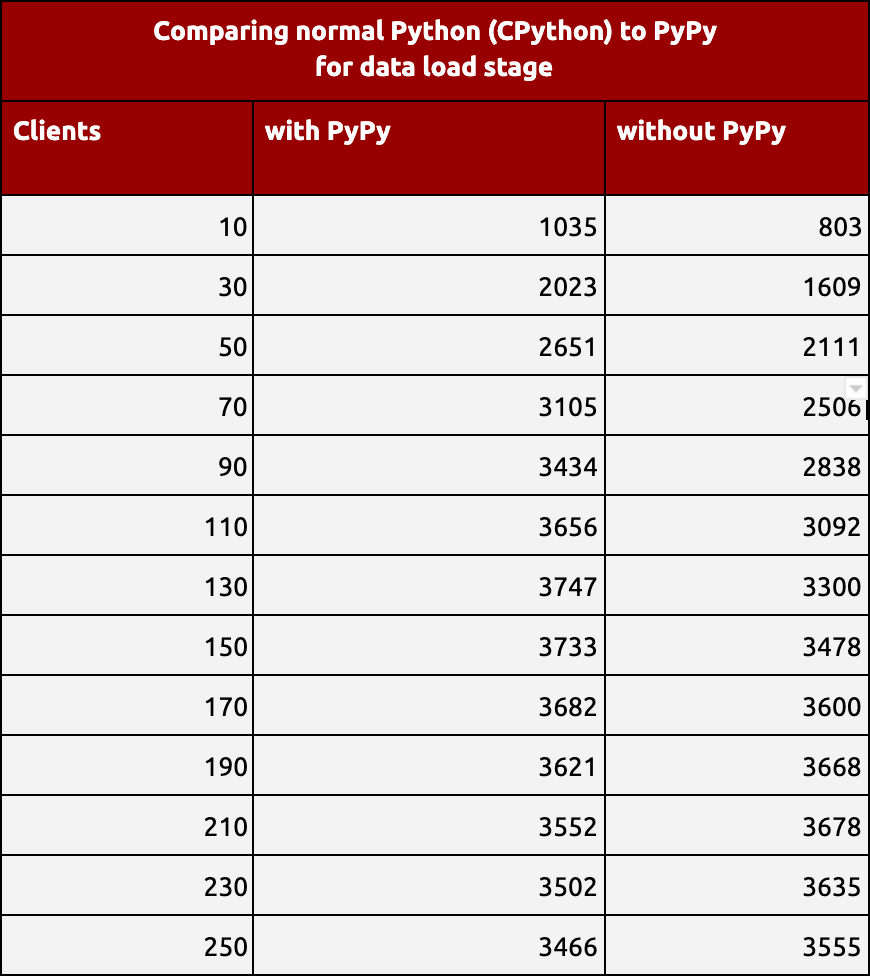
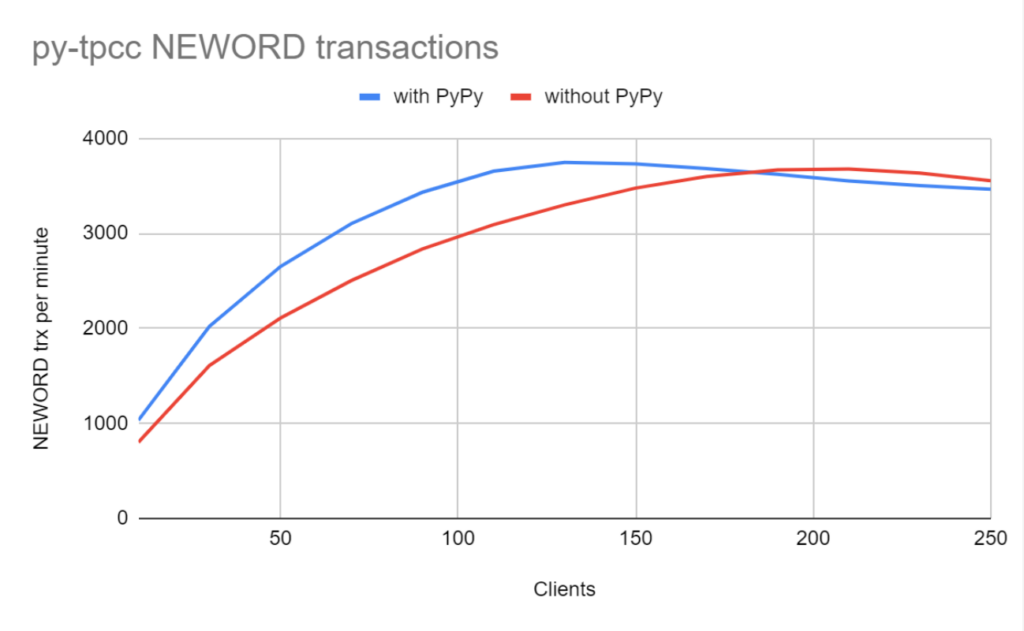
PyPy improves the results, but in this case, not by 9x times like with load data. We also can compare CPU usage on the MongoDB server-side with running py-tpcc under PyPy and without PyPy:
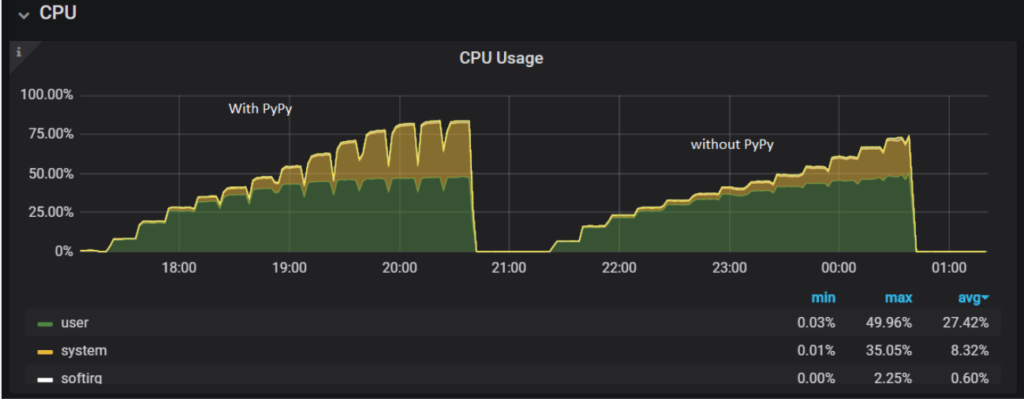
Using the client with PyPy improves the server CPU utilization, with user+system CPU being over 80% for a high number of clients.
So, I will continue to run py-tpcc under PyPy to compare different MongoDB versions
Result: NEWORDER transactions per Minute, TPM (more is better):
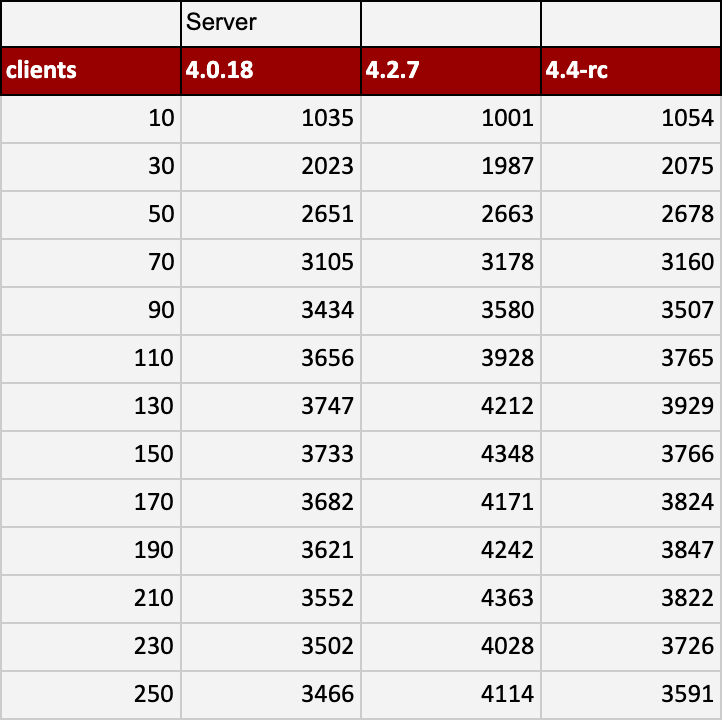
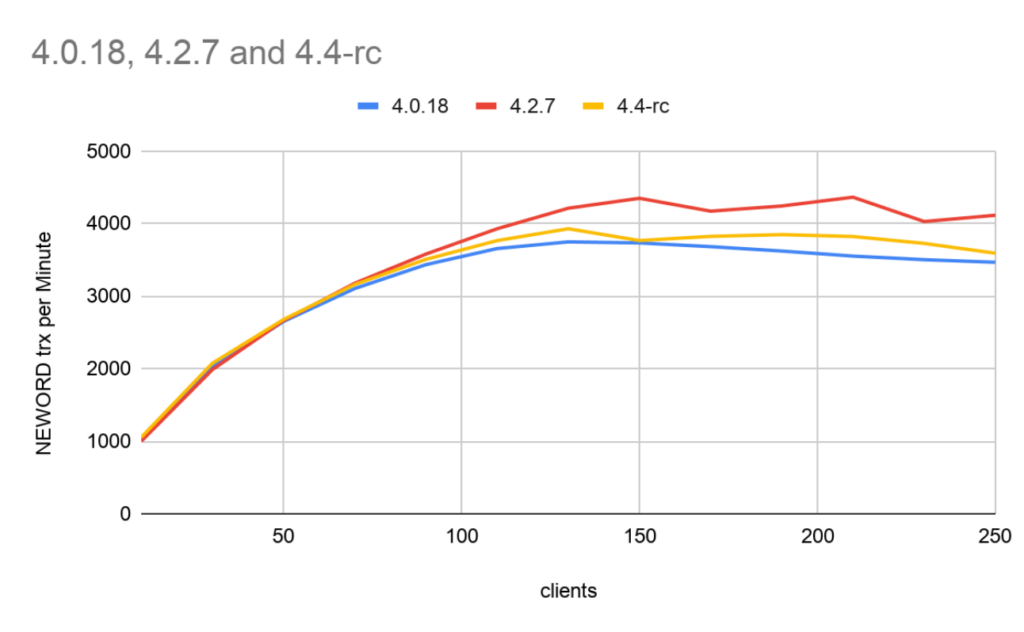
Some interesting observations:
|
1 |
numactl --interleave=all ./mongod --dbpath=/data/mongo/ --bind_ip_all --replSet node2 --slowms=10000 |
I think the py-tpcc tool proposes an interesting workload for MongoDB evaluation, and I plan to use it in the future. It seems it is beneficial to use under the PyPy environment, especially to load data into the server.
Learn more about the history of Oracle, the growth of MongoDB, and what really qualifies software as open source. If you are a DBA, or an executive looking to adopt or renew with MongoDB, this is a must-read!





Why not load the data with multiple clients? I believe you can have as many as there are warehouses (if the CPUs are there to support it).
Asya,
Indeed you can load data with multiple clients, the same way as execute the benchmark.
Hi. how many times have you ran each test? what was the variance between runs?
I remember we met for a glance talk at KubeCon 2019 🙂 I think such experiments can be made more scientific using optimizer-studio and our experiment management system which we have developed since then. check it out optimizer.concertio.com
moreover, you could use Python GC parameters tuning to get 30-50% better performance according to the benchmarks we have ran, with CPython. It will be interesting to explore how much we could improve with PyPy too. I will be glad to cooperate in such experiment.
Tomer