

(this is cross-post from https://www.percona.com/blog/)
While PCI-e Flash cards show great performance, I am often asked about alternatives, as price for PCI-e cards is still significant and not acceptable for small companies and startups.
Intel 320 SSD appears to be a popular drive with a quite acceptable price.
I wrote about write performance of these cards, and now let’s take look on a random read workload.
I used a Cisco UCS C250 as base hardware, comparing in it:
For simulating the workload I used sysbench’s fileio random reads. Scripts and raw results available on Launchpad.
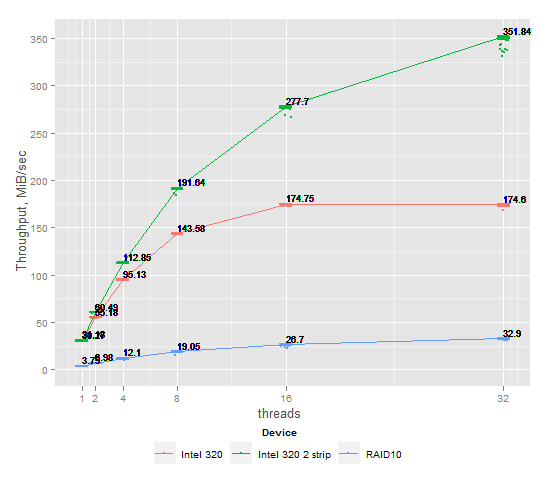
Let’s see throughput results:
| threads | Intel 320 | Intel 320 2 strip | RAID10 | ratio Intel 320 / RAID10 | ratio Intel 320 2 strip / RAID10 |
|---|---|---|---|---|---|
| 1 | 30.27 | 31.18 | 3.75 | 8.07 | 8.31 |
| 2 | 55.18 | 60.49 | 6.98 | 7.91 | 8.67 |
| 4 | 95.13 | 112.85 | 12.10 | 7.86 | 9.33 |
| 8 | 143.58 | 191.64 | 19.05 | 7.54 | 10.06 |
| 16 | 174.75 | 277.70 | 26.70 | 6.54 | 10.40 |
| 32 | 174.60 | 351.84 | 32.90 | 5.31 | 10.69 |
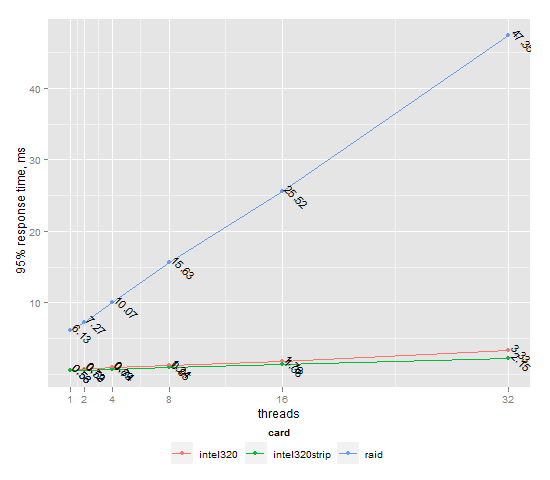
And response times:
| threads | Intel 320 SSD | Intel 320 SSD strip | RAID | ratio RAID/Intel 320 | ratio RAID/Intel 320 strip |
|---|---|---|---|---|---|
| 1 | 0.53 | 0.56 | 6.13 | 11.57 | 10.95 |
| 2 | 0.72 | 0.59 | 7.27 | 10.10 | 12.32 |
| 4 | 0.89 | 0.74 | 10.07 | 11.31 | 13.61 |
| 8 | 1.24 | 0.95 | 15.63 | 12.60 | 16.45 |
| 16 | 1.76 | 1.38 | 25.52 | 14.50 | 18.49 |
| 32 | 3.33 | 2.15 | 47.35 | 14.22 | 22.02 |
As conclusion, this card provides great read performance. A single card provides 5-8x better throughput and 10-14x better response time. Striping helps to increase throughput in 8-10x and response time in 10-22x.
While there are questions about write performance (see my previous post), I think this card is very suitable for read-intensive tasks, where you can expect significant improvements.
Resources
RELATED POSTS





FYI: Your previous post link is broken, http://www.mysqlperformanceblog.com/2011/07/29/intel-320-ssd-read-performance/%3Ca%20href=
Dathan,
Fixed, thanks.
Vadim,
You mention this as an alternative to PCI-E cards. How do they compare, performance-wise, to these SSDs?
Thanks for the benchmark results, would be interesting to see how your 160GB Intel 320 SSD compares with the faster and higher capacity 300GB and 600GB Intel 320 SSD models which on random writes is slightly faster at 23K IOPS vs 21K IOPS and write sequential speed is at 205-220MB/s vs 160GB model’s 165MB/s http://www.anandtech.com/show/4244/intel-ssd-320-review
Vadim,
I wonder how it compares to FusionIO and Virident from the top side ?
Also you did not specify the block size you used ? Is this standard sysbench with 16KB block ?
Peter,
it is 16K block size.
I have data for FusionIO 320GB MLC, just need to prepare report.
As for numbers for FusionIO:
8 threads: ~250 MiB/sec
16 threads: 300 MiB/sec
32 threads: 450 MiB/sec
64 threads: 500 MiB/sec
However it is interesting, as for some threads I have *unstable* results for read-only workloads with FusionIO.
Will,
you can find some results there
https://www.percona.com/blog/2011/06/fusionio-320gb-mlc-random-write-performance/
https://www.percona.com/blog/2011/06/intel-320-ssd-random-write-performance/
While you consider only raw performance, SATA cards may not look as alternative, but you should consider price also. For many users $10K+ for PCI-E cards is out of budget range, while 300-500$ for Intel 320 SSD is acceptable.
On a comparative question, I’m not clear on why a RAID 10 would be compared to a single drive or RAID 0 SSD array, unless it’s just a baseline for standard RAID performance.
RAID 10 is pretty much the preferred RAID method as far as real world spinning drive implementation goes, but I’m not sure I would trust a single drive SSD much more than I would trust a standard single drive, moving parts or not. It seems intuitive that SSD would stomp any traditional setup but neither of these seem like a failure proof setup to be comparing with.
….just for fun, can you graph out the Fusion IO to show relative performance?
Unfortunately the high cost of SSD doesn’t take advantage of the covenant in speed. Interesting comparison, the speed and volume of record described http://www.xtremesystems.org/forums/showthread.php?271063-SSD-Write-Endurance-25nm-Vs-34nm
Hi,
i am just wondering wether you can have a better performance and/or a more reliable system by using SSD raid 1 or 5. Do you already have tested some kind of raid 1/raid 5 array with SSD?
Regards
I tried to compare performance of mysql for reading data from ssd vs hdd . I used simple queries like ” select * from …” for records ranging from 10 to 2 lacs . I found the results quite unsatisfactory to general opinion that ssd gives very high read performance .
For records less than 100 I found on an average of 20 % increase in performance of ssd over hdd . But when records are higher than 1000 there was only upto 2-3% increase in performance of ssd over hdd .
Why does it happen ? Am i doing something wrong ? Or is it expected result
I developed it using c# ado.net and mysql as backend .
Hardware details
i7 3630 2.4 GHz core processor , 8 gb ram , 64 bit os . 1 TB samsung HDD , 64 gb samsung rbx series ssd .
Please let me know