
 MongoDB is a cross-platform, document-oriented NoSQL database. It has been developed as an answer to the growing need for easy-to-use yet very performant, scalable, and content-agnostic storage. MongoDB has been widely adopted by engineers across application development anywhere from banking to social media. Unfortunately, after MongoDB Inc.’s IPO in 2017, they chose an aggressive path of monetization, changing the license to SSPL (which is a license model that’s bad for you) and promoting Atlas (MongoDB’s Database as a Service (DBaaS) solution) even over the costly MongoDB Enterprise. The company put the community’s user needs way behind catering to high-end enterprise customers, leaving the MongoDB community stranded.
While limited by the SSPL license (not recognized by the Open Standards Initiative (OSI) as open source), Percona, known for its deep commitment to open source software, chose to come with support to the stranded MongoDB community by:
I think it’s fair to say that the list is impressive. Individuals, organizations, and even enterprises benefit from the fact that the software Percona provides is free and open.
Want to learn more about MongoDB upgrade best practices? Our eBook ‘From Planning to Performance: MongoDB Upgrade Best Practices’ is designed to offer valuable insights, strategies, and best practices to navigate through MongoDB upgrades. Read it now!

Seeing all the critical bugs that MongoDB 5.0 has introduced, it feels as if its release has been rushed, allowing for half-baked features to go GA. Looking at numerous critical problems that could result in data corruption, you could still argue that it’s a natural state of things in IT development, to quote Albert Einstein:
a person who never made a mistake never tried anything new.
True point, but following the story by The Register, is not an argument I’d use here. The “accelerated release cadence” introduced by MongoDB Inc. assumes that major improvements are released in “rapid releases” available only for Atlas (DBaaS) customers. Neither MongoDB Community nor even MongoDB Enterprise customers will get a taste of those improvements in 5.0.x, even though they have a chance to taste all the instabilities, limitations, and bugs available with 5.0.
Of course, MongoDB Inc will argue that the Rapid Releases are for the bleeding edge adopters, that they include new features, whereas all the issues are fixed in the bugfix, patchset releases. From my experience, not only bug fixes solve user issues. Think of the release cycle and the situations where, due to the deadlines, some features are released in the major version in a limited scope. It does sound all too familiar, right? Now that’s not that bad, as (with semantic versioning) minor versions will fill in the missing capabilities, lift the limitations, and make the often go-to-market spotlight features of the major version complete. Not in this case, at least not if you are the “second class citizen user” of the Community or Enterprise edition. Rapid Releases are what semantic versioning calls minor releases. Meaning you have to live with the limitations and lacking features till the next major release, for now having to satisfy with the bug-fix holding patches only.
Consider that MongoDB 5.0 introduced very appealing capabilities like time-series collections or resharding that allows for an automatic changing of a shard-key for a collection. Choosing a good shard-key during the application design when the initial sharding takes place is often challenging. Having a poorly designed sharding in your database means everything to MongoDB’s performance. For now, to change it, a manual and cumbersome process has been needed. Even taking into account the downfalls of the introduced resharding like performance and storage overhead during the process, it is still a very tempting feature that for many situations could be a game changer. Unfortunately, with a lack of trust in MongoDB 5.0 and the new release cadence not having the community’s back, the community often simply cannot benefit from it.
Percona has waited a long time for the release of 5.0 to feel stable enough to release. It was not until MongoDB 5.0.6 CE was released almost half a year after 5.0.0 that Percona decided it was safe enough for our users and customers. This sort of third-party overwatch is an invaluable asset that open source brings. With companies like Percona standing behind a software release, you get the added benefit of extra verification of your software “for free”.
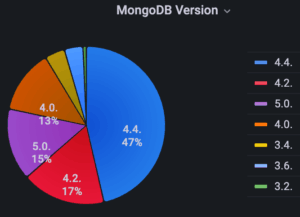 Looking at the previous chapter, the adoption of releases of 5.0 being not as impressive as one could expect is not that surprising. As this blog post is being written, the telemetry data gathered by Percona shows:
With the end-of-life calendar MongoDB 4.x looking as follows:
Add in the apparent lack of trust in 5.0, we see a growing trend for the adoption of MongoDB 4.4 that gives some “breathing space” until the EOL.
That’s a fair strategy that makes sense, but limits the value you are getting. What if there was another way that could allow you to get some more benefits?
With the introduction of MongoDB 6.0, users got long-awaited improvements and usability fixes to MongoDB 5.0 that only the Atlas customers could taste before. After the EOL of major versions that required users to upgrade, 6.0 could become their landing zone. This way users can benefit from more advanced features of the new version as well as a later EOL.
 A quick look at the features that made it to MongoDB 6.0 shows a range of interesting ones, like:
Obviously, not all of these will make it to MongoDB Community Edition, since some are reserved for MongoDB Enterprise or even Atlas only.
Even without the features not available in the Community Edition, the 6.0 release providing fixes over the unstable 5.0 is a large improvement that’s worth considering in your long-time update strategy.
While updating your Community Edition, it’s worth considering migrating from MongoDB CE to Percona Server for MongoDB. This way you have all the benefits of MongoDB CE 6.0 plus the advantages that Percona brings to the release cycle for the community. With the upcoming release of Percona Server for MongoDB 6.0, as well as the freshly released Percona Backup for MongoDB 2.0 and the support of PBM in Percona Monitoring and Management, the solution becomes complete. With features like an in-memory engine, extensive data at rest encryption, hot backups, LDAP, and Kerberos integration on top of what MongoDB Community Edition already provides, PDMDB provides a complete solution that Percona is committed to keeping open. Be on the lookout for the announcement of PSMDB 6.0 very soon!
We see over the years that companies change their licenses, becoming less open source while claiming to be more open in an obvious marketing play. At its core, Percona chooses to stay true to the open source philosophy.
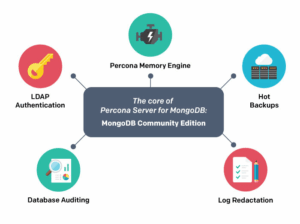
Over the years, Percona experts have meticulously delivered increments of Percona Server for MongoDB based on the same upstream codebase as the MongoDB Community Edition. As a drop-in replacement for MongoDB CE, it’s the enterprise features like these that PSMDB adds on top of it that make it so interesting:
These enterprise-grade feature enhancements were added to Percona Server for MongoDB. This way the open source community could benefit from features previously reserved only for MongoDB Enterprise customers. With PSMDB 6.0, things are not going to change. Percona is on a mission to provide open database solutions to everyone and everywhere. With this in mind, we are open to your suggestions as to which features are the most important to you, our users. Reach out and let us know!
Resources
RELATED POSTS