
TL;DR: A bug in MongoDB’s time-series collection code allows a user with the standard readWrite
role to corrupt memory within the mongod process. Best case: your database crashes, and you spend the night writing a postmortem. Worst case: an attacker is running their code as mongod, with the same access to your data that the database process itself has — every collection on that node, every index, every secret stored in it. The patch for Percona Server for MongoDB 7.0 is already available; 8.0 will be available tomorrow, and 6.0 will be available early next week.
Every time a bug like this lands, the same conversation plays out in incident channels across the industry. Are we affected? We don’t even use time-series collections! Heads nod. Everyone moves on.
That’s the mistake.
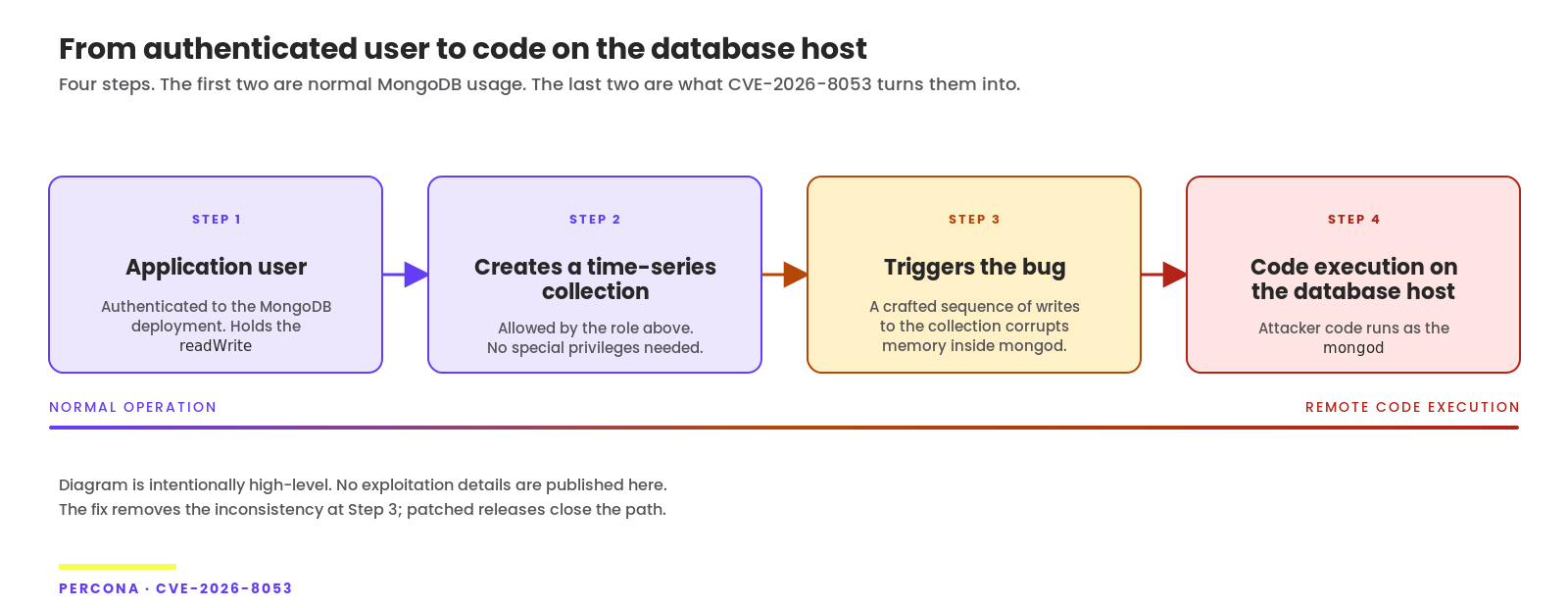
CVE-2026-8053 is an out-of-bounds memory write in MongoDB’s time-series collection — specifically in the internal mapping between measurement field names and column indexes. Under the right input, the mapping drifts out of sync with the underlying buffer and mongod writes off the end of an allocation. From there, under the right conditions, you can execute arbitrary code as the database process.
Upstream tracking lives at SERVER-126021. CVSS v3.1 puts it at 8.8. CVSS v4.0 puts it at 8.7. The labels say “High.” How that “High” translates into your week depends on a couple of assumptions worth questioning.
Read literally, the prerequisite is “an authenticated user with database write privileges.” Read operationally, that bar is lower than most teams treat it as.
Modern stacks have dozens of service accounts, with secrets scattered across config files, pipelines, and laptops you’ve long forgotten about. Others end up in log files on bad days. And every user with write access to your cluster sits one step away from the vulnerable code path. In a world like that, “the attacker would need credentials first” isn’t a speed bump — it’s a shrug.
So the real question was never authenticated vs. unauthenticated. It’s what authentication unlocks. Here, it unlocks Remote Code Execution (RCE), which is exactly what the CVSS score is trying to tell you — even if the industry’s reaction hasn’t quite caught up. Attackers don’t need your time-series collection to already exist – they just need someone’s credentials in the wrong hands, and there are more ways for that to happen than most teams want to admit.
I’m not raising this to be smug. I’m raising it because too many incident channels keep stalling on the wrong question. It isn’t: “Does our app use time-series?” It’s: “What can a user holding our readWrite role actually do this week?”
Until you patch, the answer is more than you think.
6.0 is on the End-Of-Life (EOL) track. The easy call would be to point at the lifecycle page, note that the upgrade conversation is overdue, and stop there. We’re shipping the fix anyway. Customers running 6.0 in production have real reasons they haven’t migrated yet — frozen application stacks, certification cycles, dependencies that don’t move on quarterly cadences — and none of those reasons are worth exploiting while a migration plan gets approved.
Percona is not building binary packages for the 5.x line. We’re being upfront about that — the calculus on extended support has a limit, and 5.x is past it for us. But the fix itself is already in our public release branch: release-5.0.33-26. If you have a hard requirement on 5.x and the time pressure to meet it, the source is available for building. Percona customers on 5.x can open a ticket, and we’ll work on the case individually.
Patch! Specifically:
As usual, you can download patches from your package manager or Percona Software Downloads page.
If you’re running PSMDB on Kubernetes via the Percona Operator for MongoDB, edit the image tag in your PerconaServerMongoDB custom resource and let the operator roll the cluster. Don’t wait for the June operator release to do it for you. See details in our documentation on how to Upgrade Percona Server for MongoDB.
While you’re in there, audit your custom roles. Anything granting createCollection on a production database is, today, an RCE primitive in waiting. Decide whether the service accounts that hold it actually need it. Decide whether your application users need full readWrite or whether a narrower role would do the same job. Treat the answer as part of your security posture, not as a quarterly cleanup task you’ll get to.
Questions, sharp disagreements, or a 5.x build that won’t compile? Find us on the Percona Forum or, if you’re a customer, in your support portal. If you want to become one and ensure your databases run, check out Percona Services.
Resources
RELATED POSTS