

For a long time long types like BLOB, TEXT were not supported by Percona InnoDB Recovery Tool. The reason consists in a special way InnoDB stores BLOBs.
An InnoDB table is stored in a clustered index called PRIMARY. It must exist even if a user hasn’t defined the primary index. The PRIMARY index pages are identified by 8-bytes number index_id. The highest 4 bytes are always 0, so index_id is often notated as o:<4 bytes number>, e.g. 0:258. The pages are ordered in a B-tree. Primary index is used as a key. Inside a page records are stored in a linked list.
InnoDB page by default is 16k. Obviously if a record is too long, a single page can’t store it. If the total record size is less than UNIV_PAGE_SIZE/2 – 200 (this is roughly 7k) then the full record is stored in the page of PRIMARY index. Let’s call it internal. In InnoDB sources they have type FIL_PAGE_INDEX*. If the record is longer than 7k bytes, only first 768 bytes of every BLOB field are stored internally. The rest is stored in external pages. They have type FIL_PAGE_TYPE_BLOB. Page type is stored in a FIL_PAGE_TYPE field of the page header . In an earlier post Peter described in details how BLOBs are stored.
Let me illustrate a record format of the example of the table:
|
1 2 3 4 5 6 7 |
CREATE TABLE `t1` ( `ID` int(11) unsigned NOT NULL, `NAME` varchar(120), `N_FIELDS` int(10), PRIMARY KEY (`ID`) ) ENGINE=InnoDB DEFAULT CHARSET=latin1 |
Here COMPACT format is used, which is default in MySQL >= 5.1.
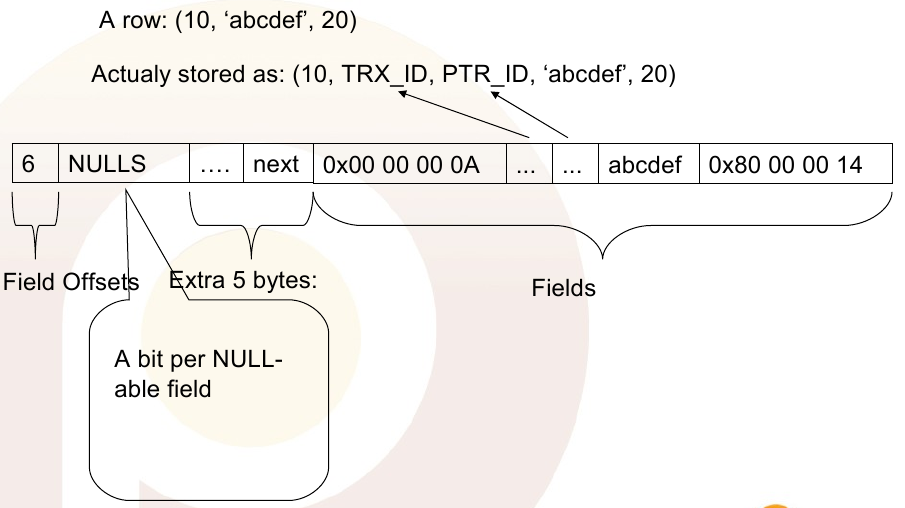
The record consists of four parts:
So if a field is the long one, it has 1) The highest bit of the offset is set to “1”, 2) After 768 bytes there are 20 bytes in the end where the following:
The external pages are linked until BTR_EXTERN_PAGE_NO is FIL_NULL.
Percona InnoDB Recovery Tool supports now recovery of long fields. It is still in development branch, but should be released after QA tests.
The complexity of BLOB fields brings prerequisites to successfully recover a record with BLOB : all pieces of the BLOB field must be reachable by pointers. That means BTR_EXTERN_PAGE_NO, BTR_EXTERN_OFFSET and BTR_EXTERN_LEN must not be corrupted.
The tool outputs the recovered table in tab-separated values format. BLOBs are printed in a hex form – 0ACD86…
To upload the table back you should utilize UNHEX function:
|
1 2 3 4 5 6 7 8 9 10 |
mysql> LOAD DATA INFILE '/path/to/datafile' REPLACE INTO TABLE FIELDS TERMINATED BY 't' OPTIONALLY ENCLOSED BY '"' LINES STARTING BY 't' (id,sessionid,uniqueid,username,nasipaddress,@var1,@var2,etc) SET blobfield = UNHEX(@var1), datefield2 = FROM_UNIXTIME(@var2,'%Y %D %M %h:%i:%s %x'); |
* – there is a typo in Recovery of Lost or Corrupted InnoDB Tables Presentation
Resources
RELATED POSTS




When you say “binary tree” (in the 2nd paragraph), do you mean “B-tree”?
Bradley,
Of course, corrected in the post.
Thanks!
Good news. Once I was forced to skip blob types when recovery innodb.
Please, don’t forgot about VARBINARY and other blob-like datatypes.
Actually the tool supports VARBINARY, because VARBINARY and VARCHAR are the same types.
However some VARBINARY values may be printed incorrectly (I think they should be printed in HEX as well).
Once it is fixed it will be fully supported.
By now the workaround is to recover varbinary the same way as varchar.