 Multiplexing Background
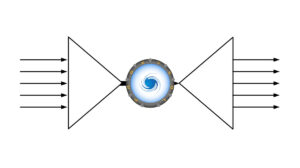
Historically it’s a technique used in networking to integrate multiple analog and digital signals via a shared medium. The goal of multiplexing over the network was to enable signals to be transmitted more efficiently for a given communication channel, thus achieving cost efficiency.
Since the term Multiplexing comes from telecommunications, the industry has heavily used a device called Multiplexers – aka Mux. There was even a term called muxing where signals were often analog and digital to be combined in a single line.
The technique was developed in the early 1870s, it’s origins to be found in telegraphy, and it has become a standard for digital telecommunications in the 20th Century.
Following multiplexing methods are currently available:
There’s the other way in telco that we aren’t going to get into too much, which is called demultiplexer. Demux involves reanalyzing composite signals to separate them.
We would basically need a Mux between the database and the application server. This means a proxy layer that can combine communication channels to the backend database. Again the goal is to reduce the overhead of opening several connections and maintaining a minimal number of open connections to reduce memory footprint.
Thread pooling is available in the following MySQL distributions:
The way they work is the listener accepts the connections and hands it over to a group of thread pools. This way each client connection is handled by the same thread pool. The above implementations aren’t as efficient as ProxySQL’s implementation.
ProxySQL comes to help when we need to Mux our communication channels to a database server, where it can often be flooded.
Main Use Cases
Goals to Achieve
Threading Models
Pros
Cons
How it works:
mysql_query_rules.multiplexing allows to enable or disable multiplexing based on matching criteria.
The field currently accepts these values:
Also, ProxySQL has some default behavior that can lead to unexpected results. In fact, ProxySQL can disable on purpose the multiplexing on a connection in the following cases:
In the majority of cases, ProxySQL can return the connection to the pool enabling the multiplexing. But only in the last case, when using session and user variables starting with @, the connections never return to the pool.
In a recent investigation on one of our client’s systems, we discovered a high amount of connections and threads used, despite the ProxySQL layer. The problem was related to queries containing the @ symbol in the Java connector when establishing a new connection. In a matter of seconds after enabling it, the multiplexing was disabled for all the connections. The effect is having no multiplexing at all: for example, 2000 connections from the front ends were reflected on the same number of connections to the back ends. We needed a way to avoid automatic disabling of multiplexing.
How to find on ProxySQL stats all the executed queries containing the @ symbol:
|
1 2 3 4 5 6 7 |
SELECT DISTINCT digest, digest_text FROM stats_mysql_query_digest WHERE digest_text LIKE '%@%'; *************************** 1. row *************************** digest_text: select @@version_comment limit ? *************************** 2. row *************************** digest_text: SELECT @@session.auto_increment_increment AS auto_increment_increment, @@character_set_client AS character_set_client, @@character_set_connection AS character_set_connection, @@character_set_results AS character_set_results, @@character_set_server AS character_set_server, @@collation_server AS collation_server, @@init_connect AS init_connect, @@interactive_timeout AS interactive_timeout, @@license AS license, @@lower_case_table_names AS lower_case_table_names, @@max_allowed_packet AS max_allowed_packet, @@net_buffer_length AS net_buffer_length, @@net_write_timeout AS net_write_timeout, @@query_cache_size AS query_cache_size, @@query_cache_type AS query_cache_type, @@sql_mode AS sql_mode, @@system_time_zone AS system_time_zone, @@time_zone AS time_zone, @@tx_isolation AS tx_isolation, @@wait_timeout AS wait_timeout *************************** 3. row *************************** digest_text: SELECT @@session.auto_increment_increment AS auto_increment_increment, @@character_set_client AS character_set_client, @@character_set_connection AS character_set_connection, @@character_set_results AS character_set_results, @@character_set_server AS character_set_server, @@init_connect AS init_connect, @@interactive_timeout AS interactive_timeout, @@license AS license, @@lower_case_table_names AS lower_case_table_names, @@max_allowed_packet AS max_allowed_packet, @@net_buffer_length AS net_buffer_length, @@net_write_timeout AS net_write_timeout, @@query_cache_size AS query_cache_size, @@query_cache_type AS query_cache_type, @@sql_mode AS sql_mode, @@system_time_zone AS system_time_zone, @@time_zone AS time_zone, @@tx_isolation AS tx_isolation, @@wait_timeout AS wait_timeout |
To create rules on ProxySQL:
|
1 2 3 4 5 |
INSERT INTO mysql_query_rules(active,digest,multiplex,apply) SELECT DISTINCT 1,digest,2,0 FROM stats_mysql_query_digest WHERE digest_text LIKE '%@%'; LOAD MYSQL QUERY RULES TO RUNTIME; SAVE MYSQL QUERY RULES TO DISK; |
And the result revealed huge savings over connections and thread pool directly captured from PMM.
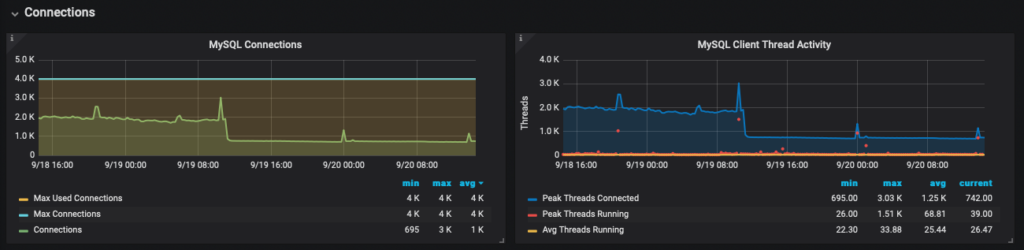
In conclusion, ProxySQL’s multiplexing feature is something every high traffic site would benefit from. What we always observe is a lower number of connections to the backend lowers the overhead of both memory utilization and context switching. In order to fully benefit multiplexing, be aware of the above limitations and investigate connection types even after implementing.
References
https://www.techopedia.com/definition/8472/multiplexing
Understanding Multiplexing in Telecommunications
https://medium.com/searce/reduce-mysql-memory-utilization-with-proxysql-multiplexing-cbe09da7921c
https://en.wikipedia.org/wiki/Multiplexing
Thanks for their valuable input :
The Anome, Multiplexing diagram, modified, CC BY-SA 3.0
Resources
RELATED POSTS