

Last time I wrote about memory allocators and how they can affect MySQL performance in general. This time I would like to explore this topic from a bit different angle: What impact does the number of processor cores have on different memory allocators and what difference we will see in MySQL performance in this scenario?
Let me share a conclusion first: If you have a server with more than 8 cores you should use something different than the default glibc memory allocator.
We recommend jemalloc or tcmalloc.
In my test I will use Dell R720 box(spec), Centos 6.3, upcoming Percona Server 5.5.30 and 3 allocators – stock glibc 2.13, jemalloc-3.1.0, the latest tcmalloc from svn repo. Regarding my selection of jemalloc version see my notes at the end of this post.
Test box has 2xIntel E5/2.2Ghz with 8 real cores per socket – 16 real cores + enabled hyper-threading gives us total – 32 vcpu. In my tests I didn’t see any notable difference between allocators up to 4 vcpu, so on charts below I will highlight results from 4 to 32 vcpu.
As test workload I will use the same 2 sysbench tests – OLTP_RO and POINT_SELECT that I used before.
Sysbench dataset – 16 tables, each 5M rows, uniform distribution.
OLTP_RO test consists of 5 select queries – select_ranges, select_order_ranges, select_distinct_ranges, select_sum_ranges, point_select. Processing these queries will involve notable amount of malloc()/free() operations, so allocator efficiency is the key factor to achieve high throughput in this test.
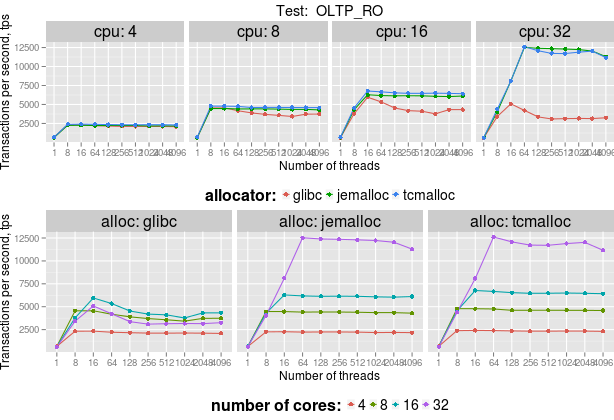
Observations:
So difference in OLTP_RO test between glibc and jemalloc/tcmalloc in case of 32vcpu is ~4x.
POINT_SELECT – very simple query – SELECT c FROM sbtest WHERE id=N. Test workload with this query
allows to generate significant load and check server behavior under very high pressure
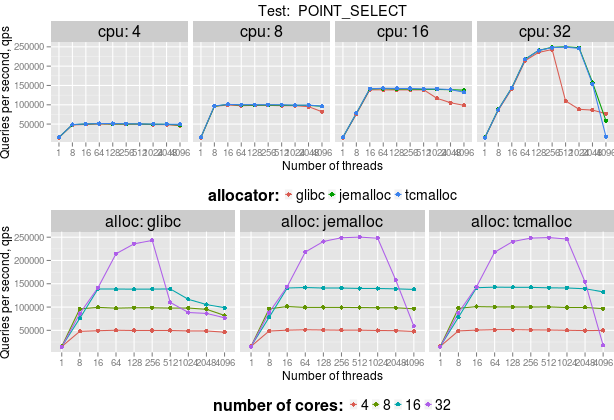
Observations:
Conclusion:
– if your box has 8 cores or less – there is almost no difference between glibc malloc and alternative allocators
– if your box has more than 8 cores – you should try/evaluate alternative allocators; it can notably boost your MySQL server at no cost. Also, an alternative allocator must be used if you run benchmarks in this configuration, otherwise the performance will be limited by glibc/malloc and not by MySQL.
Notes regarding jemalloc version I’ve used in my tests: I’ve noted notable impact on MySQL performance after version 3.2.0 (see raw results below) so I used jemalloc-3.1.0 in my tests. I suppose that some changes in 3.2.0 like for instance changes re: page run allocation and dirty page purging may have some correlation with decreasing performance in workloads with MySQL.
|
1 2 3 4 5 6 7 8 9 10 |
# Test: POINT_SELECT:throughput, QPS # # Set 1 - 5.5.30pre-jemalloc-3.0.0 # Set 2 - 5.5.30pre-jemalloc-3.1.0 # Set 3 - 5.5.30pre-jemalloc-3.2.0 # Set 4 - 5.5.30pre-jemalloc-3.3.0 # # Threads Set 1 Set 2 Set 3 Set 4 1024 236575.74 236862.59 211203.42 215098.20 2048 154829.26 154348.16 135607.69 137162.29 |
Resources
RELATED POSTS




Hello
The first question comes to mind: how do I change the allocator?
Get the source and do make;make install, or is there an easier way?
Thanks
He mentions how to use these in a previous post:
http://www.mysqlperformanceblog.com/2012/07/05/impact-of-memory-allocators-on-mysql-performance/
You just need to use LD_PRELOAD to load that library.
Shouldn’t there be some effort to improve the glibc allocator?
Hubertus,
You can get binary packages for jemalloc and tcmalloc from Centos repos or just get the sources, build and install libraries.
Regarding usage – either prefix mysqld with LD_PRELOAD – LD_PRELOAD=[/path/to/library/library.so] mysqld … or you can use –malloc-lib option for mysqld_safe script. You can also add this as variable to [mysqld_safe] section of my.cnf.
We use jemalloc in TokuDB for these reasons, and also because the memory footprint is smaller. The newer allocators, such as jemalloc and tcmalloc, do much better on long-running processes at managing physical memory. For a long running process, like mysqld, glibc seems to fragment physical memory, so that glibc actually requires substantially more memory.
Nils,
This is more question to glibc developers.
They made significant changes into MEMORY ARENAS and I guess they did not fully think through how it affects all workloads.
Another problem is that glibc fixes some issue, i.e. there are fixes in glibc 2.16, but big distros
are attached to fixed version, i.e RedHat 6.x uses glibc 2.15
a) why doesn’t mysql ship with one of the better allocators?
b) why doesn’t glibc scrap their allocator and import one of the better ones into their source tree?
MySQL binary distribution such as mysql-5.6.10-linux-glibc2.5-x86_64.tar.gz has libtcmalloc_minimal.so in lib/ directory.
MySQL RPM package for RHEL 5 (MySQL-server-5.6.10-1.rhel5.x86_64.rpm) has libtcmalloc_minimal.so, too.
But, MySQL RPM package for RHEL 6 (MySQL-server-5.6.10-1.el6.x86_64.rpm) does not have it.
I think gcc malloc became more better in RHEL 6, so MySQL team eliminated libtcmalloc_minimal.so.
If gcc malloc still has poor performance, we can report it to include libtcmalloc_minimal.so into RHEL 6 RPMs.
Ok in some distros it is available but why not always? Why doesn’t glibc physically delete their inferior code and replace it with one of the existing better alternatives?
tobi,
you are asking this in a wrong place.
You may go and file a bug report to glibc developers (actually we may do it also).
My previous report on ext4 vs xfs http://www.mysqlperformanceblog.com/2012/03/15/ext4-vs-xfs-on-ssd/
resulted that the fix for XFS is included in RedHat/CentOS 6.4
I think the reason of drops may be because jemalloc uses per-thread mmaped arena instead of centralized heap.
POINT_SELECT has very high tps results compared to other benchmarks.
And so,
I think the number of mmap systemcalll execution is related to those results.
Could Jemalloc improve performance no MySQL 5.6 on Windows 64-bit?
How could we use Jemalloc on Windows 64-bit without compiling MySQL 5.6 source code with it?
Thanks! Great article!!
Is this true on FreeBSD as well?
how to add the LD_PRELOAD ??