
A software bill of materials (SBOM) offers end users enhanced supply chain visibility, thereby facilitating license compliance and timely vulnerability detection. An SBOM of an application, library, or framework (collectively referred to as a “component”) is a machine-readable document that enumerates all other components it incorporates, including transitive ones. In this way, an SBOM represents the dependency graph of a particular component. For each component, including the one for which the SBOM is created, it provides the component’s specific version and license.
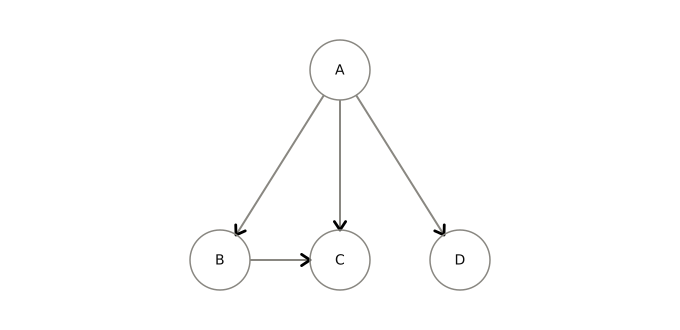
Given the dependency graph in the figure below, the SBOM for component A would include components B, C, and D. In addition, the SBOM would list each relationship between components (depicted as arrows in the figure) in its “dependencies” section.
Given an SBOM file for a component, one can scan it for vulnerabilities with one of the many available tools. If the tool doesn’t show any, it can be tempting to declare that we are safe and forget about the SBOM until the next version of the component in question is released, together with a new SBOM. That, however, would be a mistake.
SBOM scanning tools have two data inputs. The first one is an SBOM itself. It is passed to the tool explicitly and typically doesn’t change over time for a particular component version. The second data input is the complete opposite: it is implicit and updated daily or even more often. We are talking about the vulnerability database(s). SBOM scanning tools download the updates to the vulnerability database(s) before each SBOM scan. The same scan command, using the same SBOM file that previously reported no vulnerabilities, can easily report serious vulnerabilities in an hour.
That is why it is important to run scans periodically to be notified of new vulnerabilities in a timely manner and to start remediation before the component’s maintainers prepare a fix. This is especially true in the era of AI-assisted vulnerability discovery, which often leaves maintainers overloaded with vulnerability reports, so fixing takes longer than before.
Since versions 7.0.39-21, 8.0.28-12, and 8.3.7-1, Percona Server for MongoDB (further referred to as PSMDB) provides SBOMs in its binary packages. In Debian and RPM packages, one can find the SBOM in the /usr/share/doc/percona-server-mongodb-server/sbom.cdx.json file once the percona-server-mongodb-server package is installed. In the binary tarball, the SBOM is located at doc/sbom.cdx.json relative to the tarball’s root directory. As you might have already guessed, the cdx extension in the filename indicates that the SBOM is in the CycloneDX format.
Percona Server for MongoDB also provides two SBOMs for its Docker images. The first one covers PSMDB exclusively and is embedded in the image’s filesystem at the same /usr/share/doc/percona-server-mongodb-server/sbom.cdx.json path. It is the same SBOM as in the corresponding RPM package. The second one covers the image as a whole, including the base OS, libraries and utilities installed on top of it, and so on. This SBOM considers PSMDB as a dependency, and is associated with the Docker image as an OCI artifact.
Since PSMDB’s second SBOM differs little from other OCI-attached SBOMs in how it is scanned, we won’t discuss it here. One can refer to the documentation for detailed instructions and examples. Instead, the rest of the post focuses on the first SBOM: the one that is included in a Debian package, an RPM package, and a binary tarball, and embedded in the Docker image.
One can scan PSMDB’s SBOM with grype as follows:
|
1 |
grype --distro ubuntu:24.04 sbom:/usr/share/doc/percona-server-mongodb-server/sbom.cdx.json |
Clearly, they need to pass the distribution name and version they run PSMDB on, e.g.: —distro rhel:9.8.
One can also use OWASP Dependency Track. Instead of being a command-line utility, Dependency Track is a fully fledged GUI-based service. Nevertheless, deploying it is as easy as two shell commands:
|
1 2 |
curl -fsSLO https://dependencytrack.org/docker-compose.yml docker compose up -d |
Then, do the following:
http://localhost:8080 and authenticate with username admin and password adminadmin and the new passwordAt the time of writing, Grype and OWASP Dependency Track are the only tools we are aware of that can scan PSMDB’s SBOM. Other popular options, notably Trivy, skip analysis of the most PSMDB dependencies in the SBOM. This is the result of the approach to dependency management that PSMDB has to follow.
Running Grype as shown above on the SBOM from PSMDB version 7.0.39-21 gives quite a scary report (redacted for length):
|
1 2 3 4 5 6 7 8 9 10 11 12 13 14 15 16 17 18 19 20 21 22 23 24 25 26 |
$ grype --distro ubuntu:24.04 \ sbom:/usr/share/doc/percona-server-mongodb-server/sbom.cdx.json NAME INSTALLED VULNERABILITY SEVERITY EPSS unicode-org/ICU4C 57.1 CVE-2016-7415 Critical 5.8% (92nd) unicode-org/ICU4C 57.1 CVE-2017-14952 Critical 5.1% (91st) unicode-org/ICU4C 57.1 CVE-2016-6293 Critical 5.0% (91st) unicode-org/ICU4C 57.1 CVE-2017-17484 Critical 4.6% (90th) unicode-org/ICU4C 57.1 CVE-2017-7867 High 4.6% (90th) unicode-org/ICU4C 57.1 CVE-2017-7868 High 4.4% (90th) unicode-org/ICU4C 57.1 CVE-2020-10531 High 2.7% (84th) unicode-org/ICU4C 57.1 CVE-2017-15422 Medium 2.5% (82nd) unicode-org/ICU4C 57.1 CVE-2017-15396 Medium 2.2% (80th) libtom/LibTomCrypt 1.18.2 CVE-2019-17362 Critical 3.1% (86th) google.opensource/Protobuf 3.19.5 CVE-2024-7254 High 2.8% (84th) c-ares/c-ares 1.19.1 CVE-2024-25629 Medium 0.3% (27th) pcre2/PCRE2 10.40 CVE-2022-41409 High 1.1% (63rd) google.opensource/gRPC (C++) 1.46.6 CVE-2026-33186 Critical 1.6% (72nd) google.opensource/gRPC (C++) 1.46.6 CVE-2023-44487 High 100.0% (99th) google.opensource/gRPC (C++) 1.46.6 CVE-2023-4785 High 0.7% (48th) google.opensource/gRPC (C++) 1.46.6 CVE-2023-33953 High 0.5% (38th) google.opensource/gRPC (C++) 1.46.6 CVE-2023-32732 Medium 0.5% (41st) mongodb/mongodb/mongo 7.0.39 CVE-2017-2665 High 0.3% (25th) mongodb/mongodb/mongo 7.0.39 CVE-2014-8180 Medium 0.3% (19th) mongodb/MongoDB C Driver 1.27.6 CVE-2026-6231 High 0.2% (8th) mongodb/MongoDB C Driver 1.27.6 CVE-2025-12119 Low 0.2% (10th) mongodb/MongoDB C Driver 1.27.6 CVE-2026-4359 Low 0.2% (8th) |
The first thing to note about the results above is that PSMDB version 7.0.39-21 does not introduce all those vulnerabilities. They have existed for a long time in the 7.0 version series; the SBOM and the scanning tools only made them visible.
We can start sorting out this pile of vulnerabilities with the critical CVE-2026-33186 in the gRPC framework. If we read its description, we will learn that it affects only the Go implementation of the framework. The C++ implementation used in PSMDB is hosted in a separate repository (https://github.com/grpc/grpc, as opposed to https://github.com/grpc/grpc-go) and is not affected by the vulnerability. But why did Grype report it then? We believe that is a result of the quite wide Common Platform Enumeration (CPE) of this component in the SBOM file:
|
1 |
cpe:2.3:a:grpc:grpc:1.46.6:*:*:*:*:*:*:* |
In the CVEs page, CPE is cpe:2.3:a:grpc:grpc:*:*:*:*:*:go:*:* stating that only Go code is vulnerable. So the SBOM’s CPE matched the CVE’s CPE, making Grype report the vulnerability, though it is a false positive in reality.
Another gRPC vulnerability, CVE-2023-44487, does not apply to Percona Server for MongoDB either. It is exploitable only if the support of the alternative gRPC-based wire-protocol transport is enabled during the build process. It is disabled by default, though, and Percona has never enabled it.
Next, let us look at the critical CVE-2016-7415 in ICU4C, which is a C/C++ library for handling Unicode. The CVE correctly points out that version 57.1 is vulnerable to a buffer overflow. However, the PSMDB codebase has local fixes for this and other ICU4C-related CVEs. This is still version 57.1, but with fixes applied.
Finally, consider the critical vulnerability CVE-2019-17362 in LibTomCrypt. Its description says the issue is in the der_decode_utf8_string function in the der_decode_utf8_string.c file. However, Percona Server for MongoDB codebase does not even include the file: only a small part of LibTomCrypt is vendored into the PSMDB codebase, leaving der_decode_utf8_string.c aside. That brings us to the conclusion that the vulnerability does not actually affect Percona Server for MongoDB.
By now, you have probably noticed a pattern here. Many of the reported CVEs are false positives, meaning that they are reported but don’t actually affect PSMDB. One may argue that Grype produces too many of them. But there are a couple of reasons for that. First, Grype could not know about local patches for some components, components excluded from the build, or partially vendored components.
Second, if we consider the “paranoia spectrum”, where the left extreme is total naivety and the right one is being suspicious even in innocent cases, it is perfectly reasonable for a security tool to lean to the right end. In our use case, that means reporting false-positive results and leaving the analysis to a human being is a much safer choice than omitting a potential issue that could turn into a serious security breach.
Repeating the analysis we showed above for each reported CVE on the user side is tedious and sometimes difficult. In theory, a user could realize CVE-2026-33186 (an issue in the Go code) and CVE-2019-17362 (an issue in the code that doesn’t actually exist in PSMDB) are false positives. But it would be unreasonable to expect a user to dig into the internals of Percona Server for MongoDB to discover that some code is excluded from the build (CVE-2023-44487) or has local patches (CVE-2016-7415).
That is why the developers of Percona Server for MongoDB conducted the analysis themselves and prepared its results as a Vulnerability Exploitability eXchange (VEX) document. Each Percona Server for MongoDB release that comes with an SBOM file (versions 7.0.39-21, 8.0.28-12, and 8.3.7-1 and above) also has a corresponding VEX document located at https://percona.github.io/percona-server-mongodb/vex/percona-server-mongodb-<version>.vex.json. Below is an example of downloading the VEX document and using it in Grype to filter out false positives for version 7.0.39-21 (redacted for length):
|
1 2 3 4 5 6 |
$ curl -fsSLO https://percona.github.io/percona-server-mongodb/vex/percona-server-mongodb-7.0.39-21.vex.json $ grype --distro ubuntu:24.04 \ --vex=percona-server-mongodb-7.0.39-21.vex.json \ sbom:/usr/share/doc/percona-server-mongodb-server/sbom.cdx.json NAME INSTALLED VULNERABILITY SEVERITY EPSS mongodb/MongoDB C Driver 1.27.6 CVE-2026-6231 High 0.2% (8th) |
We can see that after taking a VEX document into account, only one vulnerability that actually affects PSMDB remains. What is more, a VEX document can list not only those vulnerabilities that don’t affect particular software but also those that actually do. In our case, percona-server-mongodb-7.0.39-21.vex.json says that CVE-2026-6231 would affect PSMDB only if Queryable Encryption (aka Field Level Encryption) is enabled. As a side comment, at Percona, we plan to eliminate that vulnerability in the future.
An attentive reader could have probably noticed that scanning the SBOM of Percona Server for MongoDB version 7.0.39-21 reported a couple of vulnerabilities in mongodb/mongodb/mongo, also version 7.0.39, which can look strange, but it is actually not. Percona Server for MongoDB is a fork and a drop-in replacement of MongoDB Community Edition. That is the reason every vulnerability that affects the latter also affects the former. Percona Server for MongoDB having a “dependency” on MongoDB Community Edition enables SBOM scanning tools to detect vulnerabilities in the MongoDB Community Edition code itself, in addition to those in its dependencies.
Even if an SBOM scanning tool had shown no CVEs after being passed a VEX file, we still can’t conclude that our PSMDB deployment is free from known vulnerabilities. That is because an SBOM file can’t cover dependencies linked to Percona Server for MongoDB at runtime as shared libraries. Their specific versions are governed by a particular OS and can change over time. Even if the PSMDB package for a particular OS version included shared libraries specifying their versions at build time, any upgrade of the packages on the machine where PSMDB is installed could make those versions incorrect.
In addition to periodically scanning the Percona Server for MongoDB SBOM, we recommend that users download and scan the SBOMs for the shared libraries that Percona Server for MongoDB directly links to at runtime. At the time of writing, those libraries are:
| Name | Typical Linked Library Filename(s) |
|---|---|
| GNU C Library | libc.so.6, libm.so.6, libresolv.so.2, etc. |
| GCC Support Library | libgcc_s.so.1 |
| libcurl | libcurl.so.4 |
| Cyrus SASL | libsasl2.so.2 |
| Kerberos 5 GSS-API | libgssapi_krb5.so.2 |
| OpenLDAP | liblber.so.2, libldap.so.2 |
| OpenSSL | libcrypto.so.3, libssl.so.3 |
Please note version numbers in library filenames above (e.g. 6 in libc.so.6). They are just examples and can differ from platform to platform.
Percona Server for MongoDB has provided SBOM and VEX documents since versions 7.0.39-21, 8.0.28-12, and 8.3.7-1, giving users better visibility into its supply chain for both licensing and security. Regularly scanning PSMDB’s SBOM, along with the SBOMs of the shared libraries it links to, helps operators detect potential vulnerabilities and begin remediation before they become security breaches.
Resources
RELATED POSTS