

It is time to talk again about Flow control and group replication. This time with a special eye on the use of Group Replication in the Kubernetes context. In this article we will dig a bit on how it works and what are the various side effects.
Recently I was refining the calculation I use in the MySQL calculator for Operator given I was constantly encountering a very serious problem with the Percona Server Operator.
The problem is that when the deployment was/is serving a high level of traffic, it will, no matter what, end up in getting OMMKill by the K8 system.
This because the pod was gradually consuming more and more memory, reaching the memory limit set in the CR specification.
Now let me clarify a few things, to get straight to the facts.
Kubernetes itself does not OOMKill a pod for hitting its memory limit, the mechanism works as described below with mention on how Working Set Size (WSS) is calculated, and how OOMKills are triggered, and in the resource sections, the links to the official documentation and source code.
It is crucial to distinguish between what the Linux kernel does and what Kubernetes does:
Kubernetes monitors container memory via cAdvisor, which is integrated directly into the kubelet. cAdvisor calculates the Working Set Size by taking the total memory usage and subtracting the inactive file cache (memory that the kernel can easily reclaim if it faces memory pressure).
Because active file caches and anonymous memory (like our application’s heap) cannot be easily evicted, this working set metric is the most accurate representation of the memory your container is forcing the system to hold.
The Calculation & cgroups Evolution The core mathematical calculation is Memory Usage – Inactive File Cache, but how cAdvisor fetches this data from the Linux kernel depends entirely on your node’s cgroup version. Modern cAdvisor relies heavily on the opencontainers/runc/libcontainer library to read these raw cgroup files:
The Underlying Code Logic While older versions used a static setMemoryStats function, modern Kubernetes branches handle this dynamically. The logic executes the following flow before reporting back to the kubelet:
At the end the point is that if our pod reaches the limit and we ARE NOT using the new swap feature existing in Kubernetes, our pod will be brutally killed, and in 99% of the cases our production will suffer a lot. !Ops spoiler!
To clearly understand what was causing the issue about this memory consumption and having my calculator fail, I started to collect the information about the memory usage in MySQL itself.
SELECT EVENT_NAME,CURRENT_NUMBER_OF_BYTES_USED / 1024 / 1024 AS current_usage_mb FROM performance_schema.memory_summary_global_by_event_name WHERE EVENT_NAME like ‘memory/%’ and EVENT_NAME not like ‘memory/performance%’ order by current_usage_mb desc limit 25;
Which will give you and output like this:
|
1 2 3 4 5 6 7 8 9 10 11 12 13 14 15 16 17 18 19 20 21 22 23 24 25 26 27 28 29 |
+---------------------------------------+------------------+ | EVENT_NAME | current_usage_mb | +---------------------------------------+------------------+ | memory/innodb/buf_buf_pool | 46398.92578125 | | memory/group_rpl/GCS_XCom::xcom_cache | 1066.66179943 | | memory/group_rpl/certification_info | 92.45250702 | | memory/innodb/log_buffer_memory | 64.00096130 | | memory/sql/TABLE | 49.90627003 | | memory/innodb/memory | 34.68734741 | | memory/innodb/ut0link_buf | 24.00006104 | | memory/innodb/lock0lock | 21.40064240 | | memory/mysqld_openssl/openssl_malloc | 9.51009655 | | memory/innodb/read0read | 8.19496155 | | memory/mysys/KEY_CACHE | 8.00215149 | | memory/innodb/sync0arr | 7.03147125 | | memory/innodb/ha_innodb | 6.87006950 | | memory/innodb/lock_sys | 5.25009155 | | memory/sql/log_sink_pfs | 5.00003052 | | memory/innodb/ut0pool | 4.00017548 | | memory/sql/dd::objects | 2.83031464 | | memory/innodb/std | 2.72618866 | | memory/innodb/os0file | 2.63054657 | | memory/innodb/os0event | 2.34302521 | | memory/sql/TABLE_SHARE::mem_root | 2.31734467 | | memory/innodb/trx0trx | 2.22647858 | | memory/temptable/physical_ram | 1.00003052 | | memory/sql/dd::String_type | 0.94942093 | | memory/innodb/btr0pcur | 0.89743423 | +---------------------------------------+------------------+ |
Plus I used PMM to collect memory information
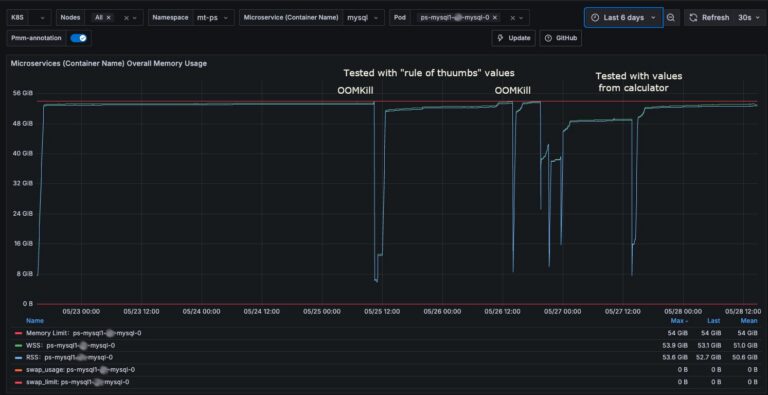
To simulate the load I used the sysbench-tpcc (tpc-c derivate test) variant and run the tests simulating a load of 1024 threads against a cluster based on machine with 16 Core and 64Gb volumes ~3k IOPS, so not gigantic but not small.
The finding was almost immediate:
|
1 2 3 4 5 6 7 8 9 10 11 12 13 14 15 16 17 18 19 20 21 22 23 24 25 26 27 28 29 |
+---------------------------------------+------------------+ | EVENT_NAME | current_usage_mb | +---------------------------------------+------------------+ | memory/innodb/buf_buf_pool | 46398.92578125 | | memory/group_rpl/certification_info | 1431.67934418 | <constantly increasing | memory/group_rpl/GCS_XCom::xcom_cache | 1066.63542366 | | memory/sql/Gtid_set::Interval_chunk | 95.52413940 | | memory/innodb/log_buffer_memory | 64.00096130 | | memory/sql/TABLE | 48.17613125 | | memory/innodb/memory | 35.08897400 | | memory/innodb/ut0link_buf | 24.00006104 | | memory/innodb/lock0lock | 21.40064240 | | memory/innodb/read0read | 14.86782837 | | memory/mysqld_openssl/openssl_malloc | 12.05916119 | | memory/mysys/KEY_CACHE | 8.00215149 | | memory/innodb/sync0arr | 7.03147125 | | memory/innodb/ha_innodb | 6.84074974 | | memory/innodb/lock_sys | 5.25009155 | | memory/sql/log_sink_pfs | 5.00003052 | | memory/innodb/ut0pool | 4.00017548 | | memory/sql/dd::objects | 2.82012177 | | memory/innodb/std | 2.72515869 | | memory/innodb/os0file | 2.63054657 | | memory/innodb/os0event | 2.35884857 | | memory/innodb/trx0trx | 2.22647858 | | memory/sql/TABLE_SHARE::mem_root | 1.83777618 | | memory/innodb/trx0undo | 1.26304626 | | memory/mysys/lf_node | 1.08828735 | +---------------------------------------+------------------+ |
Ok then … What is the certification info???
In MySQL, memory/group_rpl/certification_info is a Performance Schema memory instrument. It tracks the exact amount of RAM allocated to store the Certification Database (or Certification Info).
In Group Replication, nodes do not lock rows across the network while a transaction is executing. Instead, transactions execute locally and optimistically. When it is time to commit, the transaction undergoes a Certification Process to ensure no other concurrent transaction in the cluster has modified the exact same rows. The certification_info buffer is the in-memory hash map that makes this conflict detection possible.
The certification_info structure acts as a tracking ledger for recently modified rows.
Here is how it works under the hood:
The primary does not hold onto this memory out of stubbornness; it does so because purging that data too early would destroy the cluster’s consistency in the event of a failover.
In Group Replication, garbage collection for the certification_info buffer is not triggered just because a transaction commits on the primary. It is triggered by a concept called the Stable Set.
Every node in the cluster periodically broadcasts a message to the rest of the group saying, “Here are the GTIDs I have successfully applied to my disk.” The cluster then calculates a global low watermark. This watermark is the highest transaction GTID that every single member of the group has successfully applied. Garbage collection is only allowed to purge write-sets from the certification database that fall below this global watermark.
To note that this purge is a synchronous operation during which writes are forbidden.
When a secondary node starts lagging, its applier queue grows. This means the secondary is receiving transactions from the network quickly, but its SQL thread is too slow to actually execute them and commit them to disk.
Because the secondary hasn’t applied these transactions, it cannot report those GTIDs back to the group as “finished.”
we might wonder: If the transaction is already committed on the primary, why does the primary care if the secondary has applied it? Why not just drop the write-set from its own memory?
The answer comes down to Failover Safety and Distributed Conflict Detection. GR is a shared-nothing, decentralized architecture. Even if you are running in Single-Primary mode (keep this in mind will be important later), the underlying engine uses the exact same logic as Multi-Primary mode.
Here is why the primary is forbidden from purging that data:
Fine Marco, then what is the effect of this?
Well, drums roll …
… When a secondary node is elected as the new primary during a failover, it does not immediately open the floodgates to new writes. It keeps its super_read_only variable set to ON until it has completely drained its local apply queue of all transactions that were certified prior to the election.
This is an intentional design choice to guarantee that the new primary’s state is completely consistent with the old primary before it starts accepting new data.
The most critical impact to understand is that the new primary does not queue or pause new incoming writes while it catches up. It outright rejects them.
If our application or proxy routes a COMMIT, INSERT, UPDATE, or DELETE to the new primary while it is still processing the old queue, MySQL will immediately throw an error back to the client:
ERROR 1290 (HY000): The MySQL server is running with the –super-read-only option so it cannot execute this statement
Because of this behavior, a failover in MySQL Group Replication does not instantly restore write availability. Our cluster experiences a “brownout”, a period where reads might succeed, but writes are entirely blocked.
The duration of this write outage is directly proportional to the size of the apply queue.
If we are using a proxy layer to route your database traffic, the apply queue dictates how the proxy behaves during the transition:
During this catch-up phase, the node will accept incoming SELECT queries (since it is still a valid database). However, because it is actively churning through the old primary’s backlog, the data being read is temporarily stale.
If your application reads a row that is sitting in the apply queue but hasn’t been committed to disk yet, it will get the old version of that row.
Because a large apply queue turns a seamless failover into a severe, application-breaking write outage, Group Replication includes the Flow Control feature.
Flow Control monitors the size of the apply queues across all secondaries. If a secondary starts lagging too far behind, Flow Control should actively throttle the write throughput on the current primary to allow the lagging node to catch up. It is essentially a trade-off: we accept a slight performance hit during normal operations to guarantee that your database recovers almost instantly during a failover.
However, this is not what really happens.
Flow control does not intercept and evaluate every single transaction in real-time. Instead, it relies on a periodic polling interval governed by group_replication_flow_control_period (which defaults to 1 second).
Once a second, the cluster checks the size of the apply queues and the certifier queues.
When flow control does decide to throttle, it does not simply freeze the primary. It uses a PID (Proportional-Integral-Derivative) controller algorithm to calculate a “write quota” (the maximum number of transactions the primary is allowed to commit in the next second).
The PID controller is deliberately tuned to be gentle. It wants to gracefully degrade performance rather than cause immediate application timeouts.
This is often the silent killer that defeats flow control. Flow control makes mathematical assumptions about how fast the secondary should be able to apply transactions based on recent history.
However, the primary node might be executing writes using hundreds of highly concurrent threads. The secondary relies on the parallel applier to keep up. If the incoming workload suddenly includes transactions that cannot be parallelized, such as writes hitting overlapping rows, cascading foreign key updates, or DDL statements, the secondary’s applier instantly drops from executing in parallel down to a single, serialized thread.
When this serialization happens, the secondary’s applier rate plummets instantly. Flow control, which only checks in once a second and adjusts gradually, cannot brake the primary fast enough to compensate for the secondary suddenly dropping to a crawl.
At the moment of writing there are only two things that can be done.
We can configure Flow Control to be a bit more aggressive. It will still remain a suggestion but a strong one.
How it works (The Configuration):
The reality check, does it work?:
If the expectation is to have a rigid control over the applier queue on the lagging secondary, then the answer is NO. No matter what, at the moment flow control is not designed to act as we are used to in PXC (Percona Xtradb Cluster), where we have a rigid control of the pending queue also at the cost of delaying the writes. In Group Replication the Flow Control will never bring the write to 0, the unfortunate aspect is that the mechanism is not enough to keep the queue under control.
To help the secondary chew through the queue faster, we can increase the number of parallel threads it uses to write to disk.
How it works: We can increase the replica_parallel_workers (formerly slave_parallel_workers) setting. GR is exceptionally smart about this. Because of the certification process we discussed earlier, GR already knows exactly which transactions modify which rows. It uses a writeset-based dependency tracker to safely hand off non-conflicting transactions to multiple worker threads simultaneously.
The formula that is normally used to calculate the number of replication workers is to set 2.5 workers for each available core. IE if we have 14000m CPUs in our CR (K8) then we can assign ~35 workers, this is definitely higher than the default value of 4.
The reality check, does it work?: Yes, but only if our workload allows it.
If our absolute top priority is High Availability, specifically achieving a near-zero Recovery Time Objective (RTO), we must configure an aggressive flow control.
The problem is that Group Replication is not able to act like that today, this is something we eventually need to implement to have better HA.
If our top priority is keeping the application fast and ensuring COMMIT latencies remain extremely low, we should relax flow control or rely on the generous defaults.
If we look purely at how a single transaction flows and how a failover behaves, GR and Semi-Sync look like twins:
If they behave so similarly, why use GR at all?
The differences lie entirely in automation, consensus, and split-brain protection. Semi-Sync is just a data transport mechanism; GR is a full state-machine cluster.
Here is what GR gives you that Semi-Sync does not:
If we are using Single-Primary GR with relaxed flow control, we have essentially built a highly-automated, consensus-driven version of Semi-Sync replication.
We have the exact same apply-queue bottleneck during failover, but we have traded the need for external orchestrator tools for built-in Paxos consensus and native split-brain protection.
When we run MySQL on a traditional, dedicated Virtual Machine, memory limits are “soft.” If the certification_info database explodes and consumes an extra 10GB of RAM because of the applier lag, the Linux OS might start aggressively swapping inactive pages to disk, but the MySQL process usually survives. Performance degrades, but the database stays online.
In Kubernetes, memory limits are “hard.” As we discussed earlier, Kubernetes enforces pod memory limits via cgroups v2 (memory.max). The Linux kernel’s OOM Killer has no understanding of database quorum, failover states, or apply queues. It only sees math: Working Set Size > memory.max = Terminate Process (Exit Code 137).
If we prioritize “performance” by relaxing Flow Control in a Kubernetes environment, we are essentially setting a ticking time bomb. Here is the chain of events:
Because we tried to avoid a few seconds of write latency by keeping relaxed Flow Control, we inadvertently caused a hard crash of the primary database pod, with long write downtime.
Therefore, here is my statement as architectural law for containerized environments: In Kubernetes, High Availability and Pod stability are so intrinsically linked that Flow Control must act as hard as it can to cap the apply queue.
In a Kubernetes environment, we must tune group_replication_flow_control_applier_threshold to a strict, low number, and accept that during massive traffic spikes, our application will experience write throttling. It is infinitely better for our application’s connection pool to wait 2 seconds for a COMMIT to succeed than for the primary database pod to be violently OOMKilled by the kernel, and have to wait for minutes or hours to recover write capabilities.
Just as a mention this is exactly how Percona Operator with Percona Xtradb Cluster works. To be more specific, PXC and in general solutions based on Galera have a Flow Control mechanism that enforces the queue to be inside hard limits. While this more invasive control may be noticeable at application level, it guarantees that the other nodes are not lagging behind the primary and this is why it is a stronger HA solution in the Kubernetes environment.
https://github.com/Tusamarco/mysqloperatorcalculator
Managing Resources and OOMKills: Resource Management for Pods and Containers (This page details how memory limits are enforced reactively by the Linux kernel via OOM kills).
How WSS triggers Evictions: Node-pressure Eviction (This page explicitly details how the kubelet uses the memory.available signal, which is derived from node capacity minus the working set size).
Latest changes. Pointer to the code
Swap Memory Management (Core Concepts & Configuration): https://kubernetes.io/docs/concepts/cluster-administration/swap-memory-management/
Resources
RELATED POSTS





> If our network splits in half, an external failover tool might accidentally promote a secondary while the old primary is still alive and accepting writes.
Such a failover tool would surely stop replication or re-point replication on all of the semi-sync clients to a secondary before promoting a it to primary (otherwise the new primary would potentially refuse to commit writes).
So, semi-sync, while not providing this feature entirely on its own, can provide “Split-Brain Protection” where it is impossible (without an additional mechanism such as network or power fencing which is much more complicated to achieve) without either semi-sync, Group Replication or Galera.
> If our network splits in half, an external failover tool might accidentally promote a secondary while the old primary is still alive and accepting writes.
Such a failover tool would surely stop replication or re-point replication on all of the semi-sync clients to a secondary before promoting it to primary (otherwise the new primary would potentially refuse to commit writes).
So, semi-sync, while not providing this feature entirely on its own, can provide “Split-Brain Protection” where it is impossible (without an additional mechanism such as network or power fencing which is much more complicated to achieve) without either semi-sync, Group Replication or Galera.