
For decades, financial institutions have relied on proprietary databases to power everything from customer transactions to real-time risk engines. But the pressures facing banks, fintechs, and payment providers have changed.
Even minutes of downtime can trigger customer loss. 91% of enterprises report costs over $300,000 per hour, with 44% saying it can exceed $1 million.
At this level of operational risk, databases must scale predictably and adapt quickly. Proprietary databases often work against that goal. Escalating licensing fees, usage-based pricing, and long-term vendor lock-in make it harder to tune performance, expand capacity, or respond to incidents without compounding cost and complexity.
This is why open-source databases have become a core part of modernization efforts across banks, fintechs, and payment platforms. They help keep costs predictable as performance, security, and regulatory demands continue to rise.
Financial institutions are facing unprecedented pressure, putting legacy systems under strain and impacting performance, costs, and compliance.
Rising regulatory expectations demand continuous auditing and compliance with PCI DSS, GDPR, AML/ATF, and ESG standards. Complete transparency, high security, and verifiable controls are no longer negotiable.
The proprietary databases introduce friction, since closed architectures and licensing controls restrict the disclosure that regulators require.
Even brief transaction delays or outages trigger immediate loss of trust, especially as fintechs set the benchmark for instant, failure-proof experiences. Traditional release cycles and weekend maintenance windows no longer match customer tolerance.
AI workloads and high-dimensional data pipelines drive unprecedented data volume, outpacing the capacity of legacy systems. The rising pressure is translating into growing data center spending, which is predicted to reach $1 trillion in 2029, largely driven by these workloads.
Vendor-controlled databases slow deployment pipelines, restrict architectural flexibility, and inflate Total Cost of Ownership (TCO) as estates grow more fragmented. Teams lose velocity as they navigate outdated scaling constraints, rigid licensing, and operational silos.
Even as financial institutions modernize, proprietary databases remain a source of costly, rigid constraints that hinder real progress. Let’s see how these constraints surface in practice.
Proprietary licensing has quietly become a structural tax on modernization.
When Redis shifted to a more restrictive license, the market reaction was immediate. Nearly 75% of Redis users began exploring alternatives, and over three-quarters were already testing or migrating to new options.
For financial institutions with regulatory, uptime, and AI requirements, this goes beyond cost and starts to limit long-term decisions.
Compliance and security are typically offered as premium add-ons rather than standard features. Multi-layer encryption, detailed auditing, enterprise HA, and reliable backup may require costly upgrades. Maintaining baseline security and regulatory standards can drive unexpected spending.
In contrast, modern open-source databases come with many of these features built in or easily added, giving institutions more control instead of leaving it with the vendor.
Closed licensing gives vendors control over upgrade timing and support windows, not the institutions that run the risk. Forced version jumps and commercial changes rarely align with project roadmaps or risk calendars.
In financial services, where planned change is itself a control, this loss of autonomy introduces unnecessary operational and regulatory exposure.
Hybrid and multi-cloud have become standard operating models in finance. But proprietary engines often resist movement across regions, providers, or Kubernetes platforms.
That immobility limits options for latency optimization, data sovereignty, and disaster recovery patterns, exactly where many institutions need the most freedom.
A managed proprietary DBaaS looks attractive at first. However, at scale, the economics often flip. Percona’s analysis shows that over 74% of DBaaS users cite high and unpredictable costs as their top challenge, a direct result of opaque, usage-based pricing models.
The institutions encounter uncertain costs on IOPS, storage, backups, cross-region traffic, and autoscaling decisions that they have no full control over.
Financial institutions should not rent out their data infrastructure on conditions that may shift unexpectedly to remain competitive. That need for control, portability, and predictability is what’s driving the industry toward open source.
With the global open source database market projected to reach USD 63.48 billion by 2034, more and more financial institutions are recognizing its strategic value. Open source now gives them the control, transparency, and flexibility that proprietary databases can’t match.
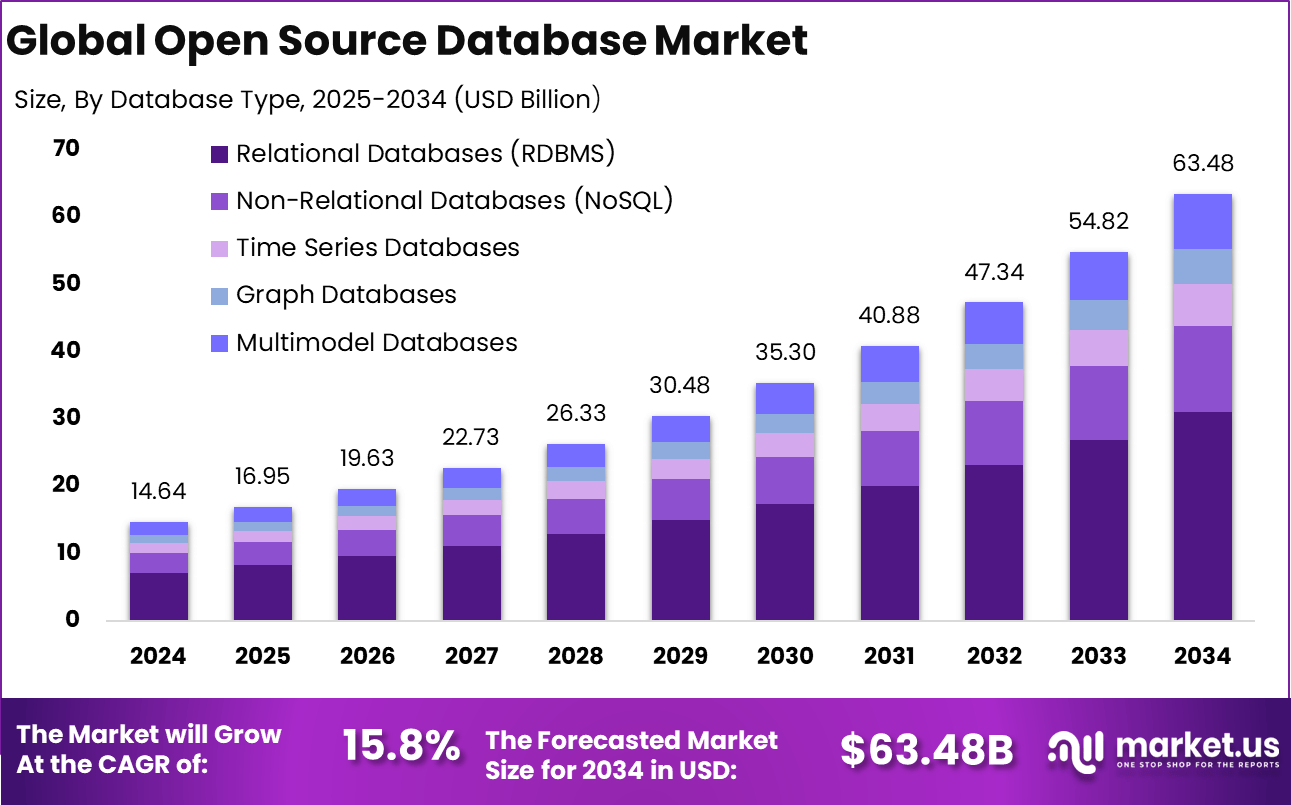
Open Source Database Market Size | Source
Let’s look at why open source now leads in every dimension that matters.
The shift to open source begins with transparency. Where proprietary vendors raise licensing fees and monetize basic compliance features, open source removes artificial cost ceilings and aligns spend with real usage. This includes:
Open source restores financial governance and eliminates unexpected cost shocks as data volumes grow. This gives organizations predictable economics and control over their database spending.
Open source scales with demand, not with licensing policy. In high-volume trading or high payment flow periods, capacity can grow vertically or horizontally without precipitating premium editions, replica fees, or per-core uplifts.
Cloud-native automation strengthens elasticity across regions, clouds, and Kubernetes environments. It enables scale-out patterns that follow real workload behavior instead of vendor-driven architecture choices.
This saves the IOPS taxes, network surcharges, and hard-and-fast capacity levels that often bloat proprietary DBaaS prices.
Financial institutions need to demonstrate every control they implement. Proprietary databases make this challenging because their security mechanisms cannot be inspected or validated.
Open source removes this barrier by giving teams full visibility into how security controls and safeguards function. That clarity sets the foundation for the capabilities that follow:
As regulatory pressure accelerates, this transparency becomes essential. Institutions strengthen compliance, reduce licensing costs, and avoid security features locked behind enterprise editions.
Financial institutions cannot tolerate unpredictable failover behavior. Open source gives architects full control over HA/DR strategy, rather than relying on opaque vendor-managed mechanisms. This includes:
HA is not a feature to buy but an architecture you can design with open source.
Modern platforms require modular, API driven, cloud native systems. Open source databases integrate naturally into:
Proprietary databases slow modernization by restricting portability, enforcing rigid architectures, and complicating automation. Open source removes these barriers and gives teams the freedom to experiment and move quickly.
Open source tooling is widely embraced by developers, SREs, architects, and data engineers, as it aligns seamlessly with how modern teams build, test, and scale software. This includes:
Open source isn’t simply a cheaper alternative, it is structurally aligned with how modern financial institutions operate. It provides the control, visibility, scalability, and freedom needed to compete in a market of data, AI, compliance, and relentless uptime requirements.
Open source provides financial institutions with flexibility and cost control. Percona turns that foundation into an operationally mature, secure, high-availability data platform suitable for regulated, always-on financial workloads.
Financial systems commonly use multiple data engines, MySQL for transactions, PostgreSQL for analytics, MongoDB for document storage, and more. Percona supports this diversity through a single engineering organization, offering:
This unified approach gives financial institutions a consistent, reliable way to operate diverse database environments at scale.
Percona’s database distributions take community editions and enhance them with features and defaults tuned for enterprise production:
This means financial teams can run open‑source databases with the predictability, operational rigor, and enterprise-grade features often associated with commercial editions.
Percona keeps your databases online:
Percona ensures open source works within your compliance framework:
Percona helps organizations modernize by migrating from proprietary databases to fully open-source solutions with minimal disruption:
Modern financial institutions are already succeeding with open-source data infrastructures built and supported by Percona. Their results show what’s possible when open-source databases are engineered, observed, and operated at enterprise scale.
Open source is now the backbone of modern financial infrastructure. When your organization is struggling with increasing costs, modernization pressure, compliance problems, or vendor lock-in, it is time to take charge.
Upgrade your databases with Percona, achieve enterprise-grade support, predictable costs, and operational control with MySQL, PostgreSQL, and MongoDB.
The future of finance is open source. Discover how institutions are reducing costs, ensuring compliance, and driving innovation.
Resources
RELATED POSTS