Choosing an open source PostgreSQL operator for Kubernetes used to be a question about features and community size. In 2026, it has become a question about licensing posture, image distribution, and whether the project you pick today will still be operationally open in three years.
This is part 1 of a 3-part series on running PostgreSQL on Kubernetes with a fully open-source operator.
In this post, you will learn about:
Open source isn’t what it used to be
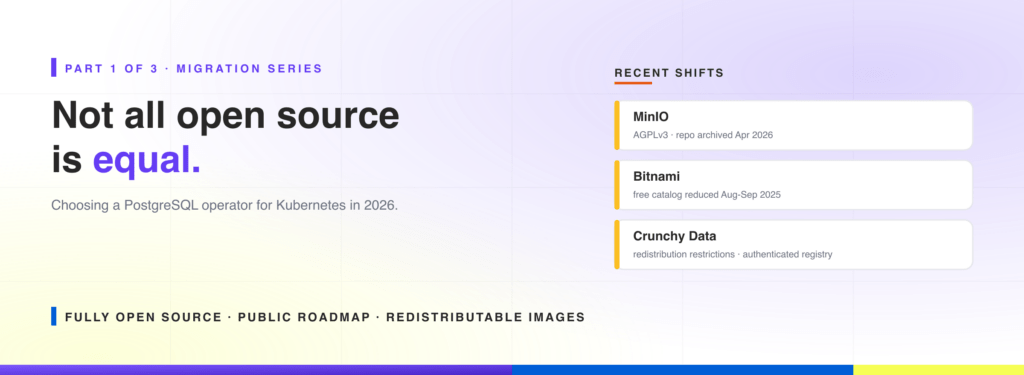
The landscape of open source has undergone significant changes in recent years, and selecting the right operator and tooling for PostgreSQL clusters in Kubernetes has never been more important. Three recent shifts illustrate the pattern.
MinIO was the default open-source S3-compatible storage backend for Kubernetes workloads for years. The trajectory over the last few years tells the story:
The code is still cloneable, but the project is no longer maintained as open source. Teams running MinIO in production now need an exit plan.
Bitnami Docker images have long been a staple for databases (including Postgres), middleware, and developer tooling. In July 2025, Broadcom’s Tanzu Division announced Bitnami Secure Images and signalled the deprecation of the free public catalog. The concrete timeline that followed:
For Kubernetes teams, the practical impact was immediate: any Helm chart that pinned a specific Bitnami image version (a recommended practice) found that image gone or moved, breaking CI pipelines and air-gapped deployments.
Crunchy Data illustrates the same dynamic in the Postgres operator space. To be clear: the Crunchy Data PostgreSQL Operator is a mature, well-engineered project, and the team behind it has done a lot of valuable work upstream and around pgBackRest and Patroni integrations. The point of this section is not the engineering, it is the redistribution and usage terms that govern the official builds.
Between 2022 and 2024, several shifts occurred:
In other words, the project is open source on the code side, but the practical artifacts (images, Helm releases) are gated.
When container images and operators come with redistribution limits, authentication requirements, or “internal-use-only” clauses, the impact on Kubernetes environments is immediate and concrete. Teams can no longer:
For a database operator, where almost every operational pattern depends on the container images you can pull and run, these restrictions effectively turn a project into a “source-available but not operationally open” solution. The code is open. The operating story is not.
As a result, many teams are switching to fully open-source alternatives: the Percona Operator for PostgreSQL, CloudNativePG, Zalando Postgres Operator, StackGres, and a few others.
The bigger picture here is that “open source” today often exists more in theory than in practice. It pays to look past the badge and check the operating reality. Three questions to ask before you commit to an operator:
If you cannot pull the official images without authentication, or you cannot mirror them to your private registry without a license review, your air-gapped and GitOps stories are constrained from day one. This is the question that turned out to be the most consequential one for MinIO, Bitnami, and Crunchy users in 2025.
Backup, monitoring, HA, and security features should be in the build everyone uses, not gated behind an enterprise tier. A “community edition” that omits the feature most teams actually need is a marketing build, not a real open-source build.
A project where you can see the issues, the PRs, and the roadmap is one you can plan around. The Percona PG Operator’s public roadmap is an example of what this looks like in practice. A project run inside a vendor’s private tracker, by contrast, gives you no visibility.
These are not gotchas. They are the questions that decide whether a project will still serve you the same way in three years.
We strongly believe in fully open-source software and want to increase our investment in the PostgreSQL and Kubernetes ecosystems. To back that up, we have decided to hard fork the Crunchy Data PostgreSQL Kubernetes Operator. Starting from version 3.0.0 , the Percona PostgreSQL Kubernetes Operator is a fully independent project, with a public roadmap, public issue tracker, and freely redistributable images.
The hard fork is not a critique of Crunchy’s engineering. It is a commitment that the operator will keep evolving in a fully open-source direction, with no surprises about which features will be available to which audience.
Because the Percona PostgreSQL Operator is a hard fork of the Crunchy operator, the migration paths are surprisingly straightforward. The same underlying tools (Patroni, pgBackRest, PgBouncer) and the same overall design are used in both, which means migration can be done in multiple ways, sometimes with near-zero downtime, sometimes faster with a small downtime window. The next two posts in this series walk through three concrete options.
This was the “why.” The next two posts are the “how”:
All three paths are reversible: because Percona’s operator, images, and tooling are 100 percent open source and remain compatible with the same backup format and the same Patroni HA model, you keep full control. You can migrate back to Crunchy if your team decides to, or out to another open-source operator (CloudNativePG, Zalando, StackGres) using the same patterns. That last journey is a topic for a future article.
This series covers basic deployment patterns and simplified configuration examples. If your environment is more complex, uses custom images, includes Crunchy enterprise features like TDE, or otherwise needs tailored migration steps, contact the Percona team and we will help you plan and execute the move.
Resources
RELATED POSTS