
Let’s be honest: Getting MongoDB up and running quickly in the cloud sounds fantastic. Services like MongoDB Atlas promise easy deployment, automated scaling, and hands-off management on AWS, Azure, and GCP. For teams looking to shed operational burdens, the appeal is tempting. Click a few buttons, get a database… what’s not to like?
However, as many teams have discovered, initial convenience can come with strings attached. Hidden costs, architectural limitations, and the creeping grasp of vendor lock-in often surface after you’re already heavily invested. You might find yourself trading long-term flexibility and control for short-term ease.
If you’re feeling squeezed by your managed MongoDB service or just exploring options, stick around. We’ll look at the real trade-offs involved and introduce an enterprise-ready, freely available alternative that keeps you in the driver’s seat.
To have a fair discussion, let’s first acknowledge what MongoDB Atlas does provide. It’s a fully managed Database-as-a-Service (DBaaS) designed to simplify running MongoDB.
What it delivers:
The core promise? Get started fast and let MongoDB Inc. handle the backend operations.
That convenience, however, comes at a price… and not just the one on the invoice.
Here’s what you might be giving up:
Your bill isn’t just about compute and storage. Expect line items for data transfer, backup storage, IOPs, and premium features like Atlas Search nodes or advanced support. This usage-based model, especially for data transfer and features, can make MongoDB cloud pricing unpredictable and surprisingly high as you scale.

This is a big one. When you build applications relying on Atlas-specific APIs and features, migrating away becomes a significant engineering challenge. You’re not just moving data; you might need to rewrite core application logic. This creates substantial MongoDB cloud lock-in, limiting your future choices.
Need flexibility? Atlas can feel restrictive. While you can choose your primary cloud provider, moving your MongoDB workload between these clouds, or migrating your data and applications off the Atlas service entirely back to your own on-premises servers, is often much harder than if you were already self-managing.
So why, exactly, is migrating away from Atlas complicated? If your applications rely heavily on Atlas-specific features, those proprietary tools don’t exist outside the Atlas environment. Moving off Atlas means you’d need to find alternatives or rewrite significant parts of your application logic, which is a major undertaking.
However, even if you do stay within their ecosystem, you have less direct control over the specific underlying virtual machine types, storage options, and network configurations compared to running MongoDB yourself on cloud infrastructure or Kubernetes. Want the freedom to easily shift MongoDB between AWS and GCP, optimize your specific hardware, or have a clear path back to on-prem if needed? Atlas’s architecture and reliance on its unique feature set can make those strategic moves much more complex and costly.
See how easy it is to migrate to Percona for MongoDB
Need to apply specific OS-level tunings for peak performance? Want fine-grained control over security configurations beyond Atlas’s offerings? Or need to deploy a specific MongoDB patch version ASAP? With a managed service like Atlas, you often lose that deep-level control. You operate within the boundaries set by the provider.
Your entire MongoDB operation (features, roadmap, pricing structure, and operational policies) is controlled by one company: MongoDB, Inc. Changes they make directly impact your setup and budget, whether you like them or not.
Does any of this sound familiar? We often hear from teams facing these exact issues:
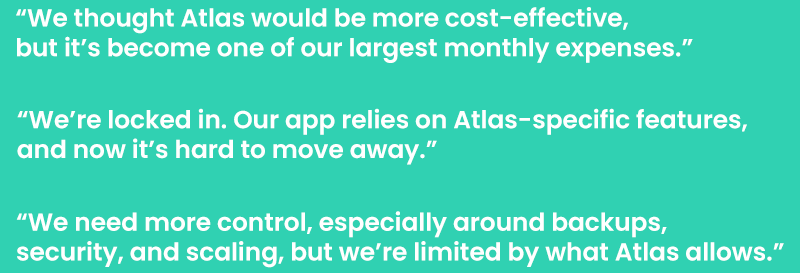
If you’re nodding along, know that you’re not alone, and there is an alternative.
Okay, so you’ve seen the potential downsides of Atlas: the unpredictable costs, the creeping lock-in, and the limits on control. If you’re looking for a way to run MongoDB that gives you back flexibility, helps you control costs, and eliminates vendor lock-in, without sacrificing enterprise capabilities, that’s exactly where Percona fits in.
Percona provides the open source or source-available software, tools, and expertise to run MongoDB effectively on your terms, wherever you need it. We help you build a production-ready MongoDB environment free from restrictive licenses and proprietary APIs.
Using Percona for MongoDB fundamentally changes your cloud strategy, putting you back in control.
MongoDB Atlas clearly offers a convenient on-ramp to using MongoDB in the cloud. But that convenience often involves trading away long-term control, accepting unpredictable costs, and risking significant vendor lock-in.
If you’re hitting the limitations of Atlas, or simply want to build a more flexible, cost-effective, and future-proof MongoDB cloud strategy, there’s a better path.
Don’t let initial ease lead to long-term constraints. Take back control of your MongoDB. Use our MongoDB pricing calculator to get a clearer view of what your cloud deployment could cost with more flexibility and fewer limitations, and if you’re not sure if MongoDB, Inc. is still the right fit, here’s what to consider: