
This blog post follows up on my previous one, How to Upgrade MongoDB Using Backups Through Many Major Versions, in which I analyzed the possibility of using backups to upgrade MongoDB through multiple major versions and ended up stumbling on a specific issue regarding restoring a particular subset of Binary data with Oplog Replay.
The Oplog Dump and the Oplog Replay tools are very important to ensure data consistency during MongoDB logical backups and restores, as they capture updates in data after the collection dumps have started for further replaying in a target deployment.
Unfortunately, the values before and after the restore differ for a specific subset of data. I should clarify that, according to my humble tests, this happens only with binary fields with subtype 2, which are byte arrays. Although this subtype is classified as (old) in the documentation, it is still possible to use it freely, so we expect it to work correctly in all instances and tools.
The problem is not localized to a cross-version restore or a single MongoDB version. I tested the scenario in all the latest minor versions from 3.6 to 8.0, with their respective mongodb-tools latest versions. For the versions before 4.4, I used the mongodump and mongorestore shipped within their Community installation packages.
The process was composed of the following steps:
The detailed steps, scripts used, and oplog dumps can be found in my repository: https://github.com/pclaudinoo/blog_posts/tree/main/oplog_replay_issue

The data comparison was the most crucial part of this investigation, so I decided to detail it a bit more. To compare two documents, I used the capacity that the mongo shell has to create a session to another server and store it in a variable. I first logged in to the target replica set:
|
1 |
$ mongo --host rsBlogTarget/localhost:27042 --authenticationDatabase admin -u testuser -p testpwd |
Then, from inside of it, I created a connection to the source one:
|
1 2 3 |
conn2 = new Mongo("mongodb://testuser:testpwd@localhost:27041/admin?replicaSet=rsBlogSource") db2 = conn2.getDB('test') coll_name="collection01" |
With that, I could query both replica sets in the same terminal session:
|
1 2 3 4 |
rsBlogTarget:PRIMARY> db2.getSiblingDB('test').getCollection(coll_name).find({_id: ObjectId('6758898aa3c2f16c28a26a78')}) { "_id" : ObjectId("6758898aa3c2f16c28a26a78"), "mode" : "bulk", "name" : "3b8B", "lastname" : "2D_F", "birthdate" : ISODate("1984-10-30T14:22:49Z"), "age" : 60, "company" : "-P9BO", "receive_sms" : false, "uuid4" : BinData(4,"TSjEvTPoEZer"), "bindata0" : BinData(0,"yg=="), "bindata2" : BinData(2,"AAAAAA=="), "bindata3" : BinData(3,"GRGcF0Md8Vu/G7DNcy93rvyuHxM="), "self_bio" : "i6=l#0K439MOXhCZN8P)2cMºveo&Vztrbn/T8H6kgM9§=4MgC6JZHmKRx7=%C51t8vHy!C1YYRD_&WJptººtooL&5/oRleYeUUªWPP/BBP=1!ok-±6±s%+Kofnz(8/vWUqem6dgCwWCjIXE±CkJª#Yhk±0_m±_+Uj§bLS++§_ltMi&G??*Vu(=§NyTdSEA)9j?#+nTER±vODJ8Is-0Qfºy6MvN)&LdªP?8§oDbk)VE9RKF-§Mf47Kz2ºWªk/ZS4tm§4J§I0%XhTQOWºe#7±UCD!&zBvnHkutvilXvomZ5#KQ-25§p#(/Ai±DT9Bz7)MiWB*2h9v&USpWsp3LvUDp)Q%7tLEGo±6E4lS_?(J-Y6bxª±dS4±P)WZ?cttCog!Ab(m!77dvI3s/Ue(sRK4#BS*S6+q?ERUO(WWa/SCªDZPDKOfOJ7/&iA)Z#ci4-Ubeu9ndFC1pldGpBY13U4UK?Okw&yygN8oo?aQr-6sOUHNzXAUfoGvcahED-x49Ci7dvkJYGyPtQO%KHª%bm2DlhebH?YhBqRMfººNP/hL(-fI4NdSCDdVcKkt?-x1ZEQGW6-Gs-_%ºx5º+ªº__69KJ/8/Ra!*31±D7ET±uhFNtbc_)Ysi5FhPTps)R!7yTnjs§=/qov7kN)5&wYDJn9&CW-kf#S_edQodQRrCCg§rmpv3ryFAYjpaFG)28iYus§t2(Z)/ZJW)Sl3Aª8+Ei7lBOO&pxyFx8Zª5#J1TS3xeLPn==IndZ5wJtªbp7±EaO0%5Vuhh1_§0º=F5Mº*+dºn4wiwºC2j#fP1Hy4(8F?BbRAwzIZ?lKBgkIXE!GsN=IVVPMªzmBU%§*)LwDdeaJd/h5!sN5±#=??!hGs=Iw+WIw8IM=s2rHzmfVlUOzTaQ+%57=±+a_3coa3Kj&Bn+2e)tj)&gpwl±knlETzgVk-HAp911M?mWLehºUR§Qx+8§h4no8C5YGUQq2Mª5xlg*OwW)9L8rv?0tp(/mªeB9zm0al+DIn9HCv3TJA)±AE+XemV-2ZG", "create_date" : ISODate("2024-12-10T18:33:46.585Z") } rsBlogTarget:PRIMARY> db.getSiblingDB('test').getCollection(coll_name).find({_id: ObjectId('6758898aa3c2f16c28a26a78')}) { "_id" : ObjectId("6758898aa3c2f16c28a26a78"), "mode" : "bulk", "name" : "3b8B", "lastname" : "2D_F", "birthdate" : ISODate("1984-10-30T14:22:49Z"), "age" : 60, "company" : "-P9BO", "receive_sms" : false, "uuid4" : BinData(4,"TSjEvTPoEZer"), "bindata0" : BinData(0,"yg=="), "bindata2" : BinData(2,"AAAAAA=="), "bindata3" : BinData(3,"GRGcF0Md8Vu/G7DNcy93rvyuHxM="), "self_bio" : "i6=l#0K439MOXhCZN8P)2cMºveo&Vztrbn/T8H6kgM9§=4MgC6JZHmKRx7=%C51t8vHy!C1YYRD_&WJptººtooL&5/oRleYeUUªWPP/BBP=1!ok-±6±s%+Kofnz(8/vWUqem6dgCwWCjIXE±CkJª#Yhk±0_m±_+Uj§bLS++§_ltMi&G??*Vu(=§NyTdSEA)9j?#+nTER±vODJ8Is-0Qfºy6MvN)&LdªP?8§oDbk)VE9RKF-§Mf47Kz2ºWªk/ZS4tm§4J§I0%XhTQOWºe#7±UCD!&zBvnHkutvilXvomZ5#KQ-25§p#(/Ai±DT9Bz7)MiWB*2h9v&USpWsp3LvUDp)Q%7tLEGo±6E4lS_?(J-Y6bxª±dS4±P)WZ?cttCog!Ab(m!77dvI3s/Ue(sRK4#BS*S6+q?ERUO(WWa/SCªDZPDKOfOJ7/&iA)Z#ci4-Ubeu9ndFC1pldGpBY13U4UK?Okw&yygN8oo?aQr-6sOUHNzXAUfoGvcahED-x49Ci7dvkJYGyPtQO%KHª%bm2DlhebH?YhBqRMfººNP/hL(-fI4NdSCDdVcKkt?-x1ZEQGW6-Gs-_%ºx5º+ªº__69KJ/8/Ra!*31±D7ET±uhFNtbc_)Ysi5FhPTps)R!7yTnjs§=/qov7kN)5&wYDJn9&CW-kf#S_edQodQRrCCg§rmpv3ryFAYjpaFG)28iYus§t2(Z)/ZJW)Sl3Aª8+Ei7lBOO&pxyFx8Zª5#J1TS3xeLPn==IndZ5wJtªbp7±EaO0%5Vuhh1_§0º=F5Mº*+dºn4wiwºC2j#fP1Hy4(8F?BbRAwzIZ?lKBgkIXE!GsN=IVVPMªzmBU%§*)LwDdeaJd/h5!sN5±#=??!hGs=Iw+WIw8IM=s2rHzmfVlUOzTaQ+%57=±+a_3coa3Kj&Bn+2e)tj)&gpwl±knlETzgVk-HAp911M?mWLehºUR§Qx+8§h4no8C5YGUQq2Mª5xlg*OwW)9L8rv?0tp(/mªeB9zm0al+DIn9HCv3TJA)±AE+XemV-2ZG", "create_date" : ISODate("2024-12-10T18:33:46.585Z") } |
I could compare their results visually or via a script. The script I used compared the fields’ lengths and their toString() and value() results. Its source can be found here: https://raw.githubusercontent.com/pclaudinoo/blog_posts/refs/heads/main/oplog_replay_issue/scripts/data_compare.js
The script fetched all _ids from the target replica set, found them in the source, and compared field by field. The output result when they mismatch is this:
|
1 2 |
Collection: collection01, _id: 67588d39470199a7c6a2865f field bindata2 toString does not match: ^@^@^@^@, / value does not match: ^@^@^@^@, / length does not match: 4, 0 Collection: collection01, _id: 67588d3a470199a7c6a286b3 field bindata2 toString does not match: ^@^@^@^@, / value does not match: ^@^@^@^@, / length does not match: 4, 0 |
After finding a mismatch, I would then compare the whole document in both the collection01 and the oplog collections, on both source and target, to double-check the error visually:
|
1 2 3 4 5 6 7 8 9 10 11 |
// collection01 rsBlogTarget:PRIMARY> db2.getSiblingDB('test').getCollection(coll_name).find({_id: ObjectId('67588d39470199a7c6a2865f')}) { "_id" : ObjectId("67588d39470199a7c6a2865f"), "mode" : "no_bulk", "name" : "eVwG", "lastname" : "EjIG", "birthdate" : ISODate("1971-08-23T05:22:17Z"), "age" : 45, "company" : "7H?/v", "receive_sms" : false, "uuid4" : BinData(4,"Z/F5K+/52RyLmyHvr4TMHAE="), "bindata0" : BinData(0,"UEpI9xufT8cc"), "bindata2" : BinData(2,"AAAAAA=="), "bindata3" : BinData(3,"wzOx/ZoO/Cb3stliR8iPXuTbYA=="), "self_bio" : "p0x7rl8OY3sO+0y1A_0Ol%Hhb&W?G-mY", "create_date" : ISODate("2024-12-10T18:49:29.313Z") } rsBlogTarget:PRIMARY> db.getSiblingDB('test').getCollection(coll_name).find({_id: ObjectId('67588d39470199a7c6a2865f')}) { "_id" : ObjectId("67588d39470199a7c6a2865f"), "mode" : "no_bulk", "name" : "eVwG", "lastname" : "EjIG", "birthdate" : ISODate("1971-08-23T05:22:17Z"), "age" : 45, "company" : "7H?/v", "receive_sms" : false, "uuid4" : BinData(4,"Z/F5K+/52RyLmyHvr4TMHAE="), "bindata0" : BinData(0,"UEpI9xufT8cc"), "bindata2" : BinData(2,"BAAAAAAAAAA="), "bindata3" : BinData(3,"wzOx/ZoO/Cb3stliR8iPXuTbYA=="), "self_bio" : "p0x7rl8OY3sO+0y1A_0Ol%Hhb&W?G-mY", "create_date" : ISODate("2024-12-10T18:49:29.313Z") } // oplog rsBlogTarget:PRIMARY> db2.getSiblingDB('local').getCollection('oplog.rs').find({"o._id": ObjectId('67588d39470199a7c6a2865f')}) { "lsid" : { "id" : UUID("8792d733-13f6-4103-844e-97e8bf72e3e8"), "uid" : BinData(0,"AFRKns4A5Cw1N/JwEr9PYhaJfg9avn0rWp9KjbtfX6w=") }, "txnNumber" : NumberLong(7245), "op" : "i", "ns" : "test.collection01", "ui" : UUID("0bbdc214-86fa-4476-97b8-7e0b5f0ccfb6"), "o" : { "_id" : ObjectId("67588d39470199a7c6a2865f"), "mode" : "no_bulk", "name" : "eVwG", "lastname" : "EjIG", "birthdate" : ISODate("1971-08-23T05:22:17Z"), "age" : 45, "company" : "7H?/v", "receive_sms" : false, "uuid4" : BinData(4,"Z/F5K+/52RyLmyHvr4TMHAE="), "bindata0" : BinData(0,"UEpI9xufT8cc"), "bindata2" : BinData(2,"AAAAAA=="), "bindata3" : BinData(3,"wzOx/ZoO/Cb3stliR8iPXuTbYA=="), "self_bio" : "p0x7rl8OY3sO+0y1A_0Ol%Hhb&W?G-mY", "create_date" : ISODate("2024-12-10T18:49:29.313Z") }, "o2" : { "_id" : ObjectId("67588d39470199a7c6a2865f") }, "stmtId" : 0, "ts" : Timestamp(1733856569, 37), "t" : NumberLong(1), "v" : NumberLong(2), "wall" : ISODate("2024-12-10T18:49:29.316Z"), "prevOpTime" : { "ts" : Timestamp(0, 0), "t" : NumberLong(-1) } } rsBlogTarget:PRIMARY> db.getSiblingDB('local').getCollection('oplog.rs').find({"o._id": ObjectId('67588d39470199a7c6a2865f')}) { "op" : "i", "ns" : "test.collection01", "ui" : UUID("0e5152f4-3c4b-43c7-b936-ce2e2a70fa65"), "o" : { "_id" : ObjectId("67588d39470199a7c6a2865f"), "mode" : "no_bulk", "name" : "eVwG", "lastname" : "EjIG", "birthdate" : ISODate("1971-08-23T05:22:17Z"), "age" : 45, "company" : "7H?/v", "receive_sms" : false, "uuid4" : BinData(4,"Z/F5K+/52RyLmyHvr4TMHAE="), "bindata0" : BinData(0,"UEpI9xufT8cc"), "bindata2" : BinData(2,"BAAAAAAAAAA="), "bindata3" : BinData(3,"wzOx/ZoO/Cb3stliR8iPXuTbYA=="), "self_bio" : "p0x7rl8OY3sO+0y1A_0Ol%Hhb&W?G-mY", "create_date" : ISODate("2024-12-10T18:49:29.313Z") }, "o2" : { "_id" : ObjectId("67588d39470199a7c6a2865f") }, "ts" : Timestamp(1733856811, 299), "t" : NumberLong(1), "v" : NumberLong(2), "wall" : ISODate("2024-12-10T18:53:31.601Z") } |
It is possible to see in both that the source holds the value BinData(2,”AAAAAA==”) while the target holds BinData(2,”BAAAAAAAAAA=”). After that confirmation, I would compare it with the oplog BSON file generated by mongodump:
|
1 2 3 4 |
$ bsondump --outFile=oplog_dump.json --bsonFile=dump/oplog.bson $ grep '67588d39470199a7c6a2865f|67588d3a470199a7c6a286b3' oplog_dump.json {"lsid":{"id":{"$binary":{"base64":"h5LXMxP2QQOETpfov3Lj6A==","subType":"04"}},"uid":{"$binary":{"base64":"AFRKns4A5Cw1N/JwEr9PYhaJfg9avn0rWp9KjbtfX6w=","subType":"00"}}},"txnNumber":{"$numberLong":"7245"},"op":"i","ns":"test.collection01","ui":{"$binary":{"base64":"C73CFIb6RHaXuH4LXwzPtg==","subType":"04"}},"o":{"_id":{"$oid":"67588d39470199a7c6a2865f"},"mode":"no_bulk","name":"eVwG","lastname":"EjIG","birthdate":{"$date":{"$numberLong":"51772937000"}},"age":{"$numberInt":"45"},"company":"7H?/v","receive_sms":false,"uuid4":{"$binary":{"base64":"Z/F5K+/52RyLmyHvr4TMHAE=","subType":"04"}},"bindata0":{"$binary":{"base64":"UEpI9xufT8cc","subType":"00"}},"bindata2":{"$binary":{"base64":"AAAAAA==","subType":"02"}},"bindata3":{"$binary":{"base64":"wzOx/ZoO/Cb3stliR8iPXuTbYA==","subType":"03"}},"self_bio":"p0x7rl8OY3sO+0y1A_0Ol%Hhb&W?G-mY","create_date":{"$date":{"$numberLong":"1733856569313"}}},"o2":{"_id":{"$oid":"67588d39470199a7c6a2865f"}},"stmtId":{"$numberInt":"0"},"ts":{"$timestamp":{"t":1733856569,"i":37}},"t":{"$numberLong":"1"},"v":{"$numberLong":"2"},"wall":{"$date":{"$numberLong":"1733856569316"}},"prevOpTime":{"ts":{"$timestamp":{"t":0,"i":0}},"t":{"$numberLong":"-1"}}} {"lsid":{"id":{"$binary":{"base64":"h5LXMxP2QQOETpfov3Lj6A==","subType":"04"}},"uid":{"$binary":{"base64":"AFRKns4A5Cw1N/JwEr9PYhaJfg9avn0rWp9KjbtfX6w=","subType":"00"}}},"txnNumber":{"$numberLong":"7329"},"op":"i","ns":"test.collection01","ui":{"$binary":{"base64":"C73CFIb6RHaXuH4LXwzPtg==","subType":"04"}},"o":{"_id":{"$oid":"67588d3a470199a7c6a286b3"},"mode":"no_bulk","name":"7ZhM","lastname":"Z++N","birthdate":{"$date":{"$numberLong":"1624873736000"}},"age":{"$numberInt":"72"},"company":"&Qka)","receive_sms":false,"uuid4":{"$binary":{"base64":"Ca+rfQ==","subType":"04"}},"bindata0":{"$binary":{"base64":"3DABOW5khBPMUOZ2OplwwevQiuve","subType":"00"}},"bindata2":{"$binary":{"base64":"AAAAAA==","subType":"02"}},"bindata3":{"$binary":{"base64":"pAPY3IcWJR35InOR4oa8ek/kCduu","subType":"03"}},"self_bio":"TiE%xB9ckrª#*sN08O0KdwohBC-*zI)2","create_date":{"$date":{"$numberLong":"1733856570041"}}},"o2":{"_id":{"$oid":"67588d3a470199a7c6a286b3"}},"stmtId":{"$numberInt":"0"},"ts":{"$timestamp":{"t":1733856570,"i":7}},"t":{"$numberLong":"1"},"v":{"$numberLong":"2"},"wall":{"$date":{"$numberLong":"1733856570044"}},"prevOpTime":{"ts":{"$timestamp":{"t":0,"i":0}},"t":{"$numberLong":"-1"}}} |
And the field bindata2 holds the same value as the client: {“$binary”:{“base64″:”AAAAAA==”,”subType”:”02″}}. Somehow, some versions of the Oplog Replay feature of mongorestore transform this value to something else when writing to the target. Unfortunately, I don’t have enough knowledge to dive deep into its source code and find out why, so I created the following ticket to report it: https://jira.mongodb.org/browse/TOOLS-3730.
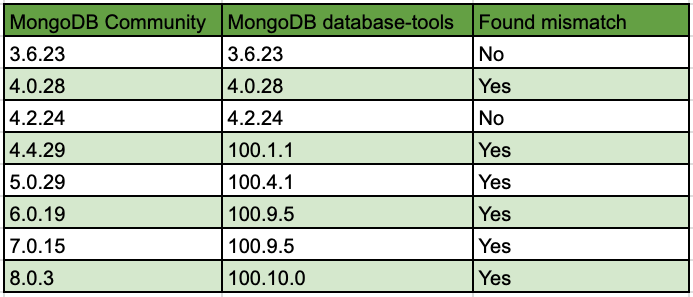
Besides the matching results in each case, I could spot some other issues in my tests:
The blog post that originated this one was about using backups to upgrade MongoDB and the potential issues we can find. This one expanded the investigation about potential data consistency issues using backups and restores in general, leading us to reinforce that it is crucial to test our backups regularly, including tools to compare and validate samples of documents when possible, so we don’t have unpleasant surprises when we need to recover from a disaster or replicate an environment. Percona Experts are available 24/7 to assist you with these and other issues with your MongoDB deployments.
Whether you’re a seasoned DBA well-versed in MongoDB or a newcomer looking to harness its potential, this ebook provides the insights, strategies, and best practices to guide you through MongoDB upgrades, ensuring they go as smoothly as possible and your databases remain optimized and secure.
From Planning to Performance: MongoDB Upgrade Best Practices