

I still continue to run benchmarks of different SSD cards. This time I show numbers for Virident FlashMAX 1400. This is a MLC PCIe SSD device. There are couple notes on these results.
First, this time I use a different server. For this benchmark it is Cisco UCS C250, while for previous results I used HP ProLiant DL380 G6.
Second note is, that I use a mode “turbo=1” for Virident card. What does that mean? Apparently PCIe specification has a limitation on available power. If I am not mistaken it is 25W, however Virident to provide full write performance requires 28W. And while many servers can handle 28W on PCIe, this is a non-standard mode, and Virident by default uses 25W (turbo=0). To force full power, I load a driver with turbo=1. I also use “maxperformance” formatting for Virident, which gives less capacity (1.2TB visible for user), but reserves internally more space to provide better write performance.
So as usually I start with random writes, async.
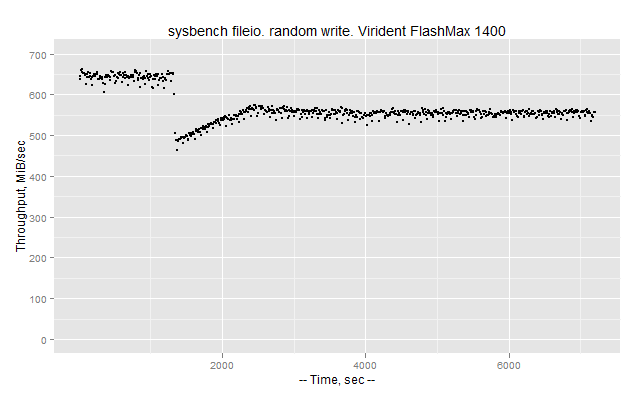
Soon after initial period, the result stabilizes at 550 MiB/sec level.
Random read, async: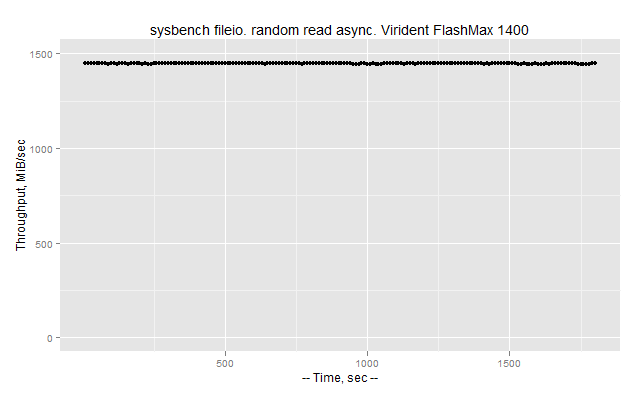
Random read throughput is very close to perfect line, and it is 1450 MiB/sec.
This is best read throughput I’ve seen so far in my benchmarks.
To see distribution of response time, the results for random read synchronous IO.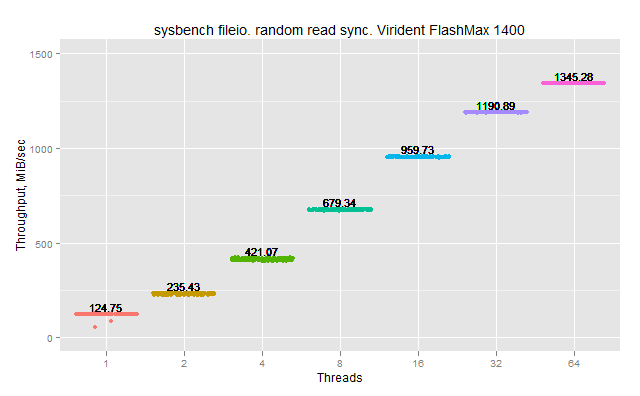
There we can see that 1450 MiB/sec is not quite achievable in sync mode, and only 64 threads are getting close.
Response time: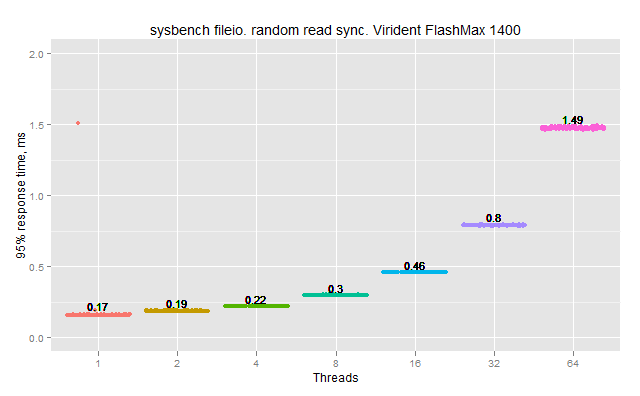
In the conclusion, from all tested cards, Virident FlashMAX shows the most stable results and the best absolute performance so far.
For reference, other results in series:
Resources
RELATED POSTS




Hi Vadim,
Is there any indication that running in Turbo=1 with at 28W would shorten the life of the card?
Does the lost 200GB go to the wear leveling and garbage collection pool because it is performing at a higher rate?
Best Regards.
Austin,
I am not aware that Turbo=1 affects life time by itself.
It is just that wit turbo=1 you will be able to perform more writes per second,
and if you do, then physical time of life may be shorter, because you will use all 15PB of writes in shorter period of time.
Great write-up as usual, and remarkable performance from this vendor.
That said, since there are now several variables in play (new harness, new wattage, “performance mode”). I would love to see data to compare the individual impact of the separate variables. How does the new Cisco hardware effect of another well performing vendor? How much does “turbo” and “max performance” affect card performance? I realize they are a part of the total package, but it’s nicer to understand things when compared evenly.
Could you post a comparison of the FlashMAX 1400 maxperformance and maxcapacity modes? Is the performance equal at lower write loads?